Revolutionary Cult Gallery
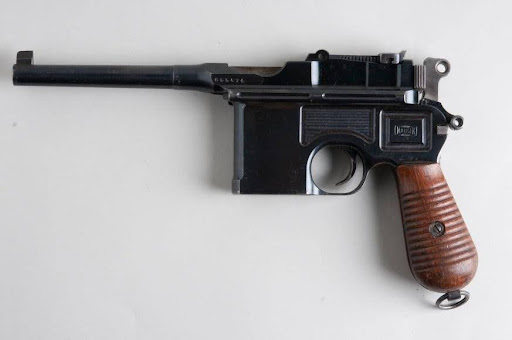
The Rodda company arms heist took place on 26 August 1914 in Kolkata. Members of the Jugantar Party intercepted a shipment of Mauser Pistols and ammunition belonging to Rodda & co., a famous gun dealer, while these were en route from the customs to the company’s godown, and were able to make away with a portion the arms. The heist was a sensational incident, being described by The Statesman as the “Greatest daylight robbery”. In the following years, the pistols and ammunitions were linked to almost all the instances of nationalist struggles in Bengal.
The Delhi Conspiracy
On December 23, 1912, Lord Hardinge came to Delhi from Shimla for a ceremonial declaration about the transfer of capital from Kolkata to Delhi. A huge procession was organized for the Viceroy. Numerous people and fifty elephants were present in the procession, and there was large gathering on both the sides of the road. The Viceroy and his wife was seated howdah placed on an elephant and as they reached Chandni Chawk, there was an ear-slitting sound of a big explosion. The Viceroy got injured and his wife escaped injuries and two others died. The blast created immediate panic among the huge gathering, Hardinge was taken for medical care and his life was saved.
The blast was master-minded by young revolutionary from Chandannagar Rashbehari Bose and he was accompanied by Basanta Kumar Biswas to execute the plan to assassinate Lord Hardinge. The bomb was thrown by Biswas but somehow the Viceroy escaped the attack, both the revolutionaries could flee from the place as par plan. The attack shook the foundations of the empire in India, as the government declared rupees one lakh reward for providing information about the attackers but the two revolutionaries remained untraced. The case was termed as the Delhi Lahore Conspiracy.
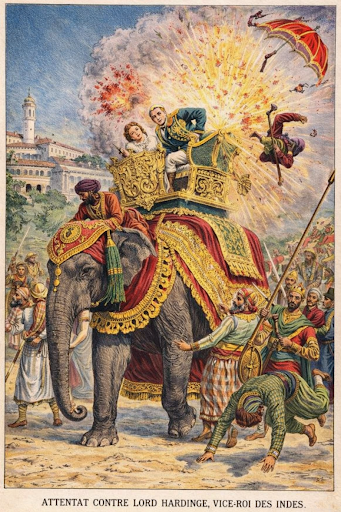
(this image is in public domain, improved using AI)
Famous portrait showing bomb attack on Lord Hardinge in Delhi
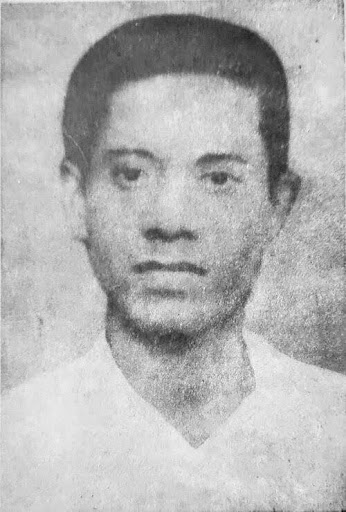
(this image is in public domain, collected from Wikipedia)
Biswas was born on 6 February 1895 at Poragacha village in Nadia district of Bengal. At a very young age Basanta became a member of Jugantar Party & was known for his organisation skills. He met Rash Behari Bose in Dehradun in 1908 and he was trained to carry out missions. Biswas was brought to Lahore by Rashbehari Bose in October 1912 and was assigned the responsibility to throw a bomb at the Viceroy to assassinate him in Delhi, as part of the mega plan. Basanta threw a bomb at the Viceroy during a procession, however, he was not successful in his attempt but he could successfully escape. Almost after two years police could arrest him from his home in Nadia, where he was present to perform the last rites for his father. On May 11, 1915 at Ambala Central Jail in Punjab, the brave revolutionary was hanged at an age of 20 years.
Revolutionaries Executed
First World War started in 1914 and Britain declared against Germany. In India revolutionaries drew a mega plan of triggering a revolt among the Indian army men of the British Indian army and to end British rule by taking advantage of the war situation. Rashbehari Bose was one of the principal leaders of the plan or the movement, known as the “Ghadar Movement”. But the movement failed, Bose escaped to Japan and continued his activities to liberated India. On the other hand, in the Delhi Lahore Conspiracy case, revolutionaries Basanta Biswas, Avodh Bihari, Amir Chandand and Balmukund were convicted in 1941and were executed on March 1, 1915.
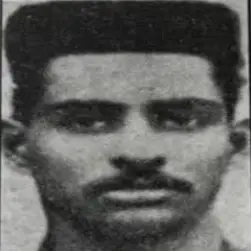
(this image is in public domain, collected from chakrafoundation.org)
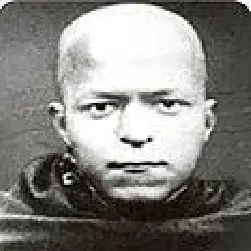
(this image is in public domain, collected from Wikipedia)
Revolutionaries fight back
As a result of the Alipore Bomb Case, many revolutionaries from Bengal were imprisoned, sent to the Andamans, Arabinda Ghose left politics, takes the path of spiritualism and setup a ashram in Pondicherry. However, the fire of revolution did not die down and a number of secret societies came up within quick time. the freedom fighters strategized mega plans and started executed those.
1. Collection of arms: The guns used by the revolutionaries (revolvers, pistols, etc.) were procured by the way of theft and purchase from sea-men and junior officers of the foreign ships. There is a famous incident of theft of a big consignment of arms and ammunitions of the Rodda and Company in Kolkata and the bullets and mauser pistols were distributed among the revolutionaries.
The fascinating story of the Rodda Arms Heist
It was in August 1914, when a meeting of the revolutionaries took place in a narrow lane of lower Chitpur Road named Chatawala Gali near Lalbazar in Kolkata. It was summoned by Anukul Mukherjee of revolutionary group Atmonnati Samiti and Dhaka Mukti Sangha’s Srish Paul.
During the First World War (1914-1918) Indian revolutionaries were in desperate need of firearms to helm an armed struggle for Indian Independence, across the country. Revolutionary leaders Rash Behari Bose and Bagha Jatin or Jatindranath Mukhopadhyay were among the masterminds of this movement.
The Atmonnati Samiti was founded by Bipin Behari Ganguly and had its base at 39, Malanga Lane, Kolkata. Besides Anukul Mukherjee, some of its members were Girin Banerjee and Kalidas Basu. Bagha Jatin had tasked Bipin Behari Ganguly with procuring arms which would give ammunition to their pan-India movement.
Atmonnati Samiti was collaborating with revolutionary Hem Chandra Ghosh and Ullaskar Datta to plan an arms heist. The very final meet for the robbery was to take place at Chatawala Gali. One of Bipin Behari’s close friends Kalidas Mukherjee was employed at Rodda & Co, a prominent gun store situated at the time in Vansittart Row in Calcutta. With his help, Anukul was able to get a young man employed at Rodda & Co., his name was Shrish Mitra alias Habu. Shrish was an informer for the revolutionaries at Rodda and Company and soon became a trusted employee of Mr. Prike.
Shortly after, Shrish Mitra informed his peers that a large consignment of German Mausers had arrived at Calcutta for Rodda and Co. The Mauser C96 was a long barrel gun with the box magazine located in front of the trigger with a round wooden handle along with a wooden shoulder stock.
As per the plan, the pistol and cartridges were to be released from customs by Srish Mitra on behalf of Rodda and Company on August 26. Revolutionary Haridas Datta was to guide a bullock cart to Malanga Lane from Custom Office with the stolen pistols and bullets. Shrish Pal and Khagen Das were to walk beside the cart guarding him. A young revolutionary named Prabhu Dayal Himmatsingka was assigned to the job to give Haridas Datta a makeover so he could resemble a Hindusthani Garowan.
On August 26, Srish Mitra reported to Mr. Prike (an officer of Rodda and Company) at 10 am as usual and Mr. Prike handed him all the necessary documents. When the bullock carts left the Custom House, Haridas Datta drove the bullock cart like an expert Garowan on the streets of Dalhousie Square, Shrish Pal and Khagen Das came silently from their designated waiting spot and started walking on either side of the cart. At the entry of Vansittart Row, the six bullock carts went inside the lane towards the Godown of Rodda & Co. Srish Mitra accompanied the carts towards the Godown. The seventh cart driven by Haridas Datta did not turn right into Vansittart row. Instead, it went straight. It was unloaded in front of a godown (or stockyard) on B.B. Ganguly Street belonging to one Kanti Mukherjee near the entrance of Malanga Lane. The boxes were delivered to the house of Bhujanga Bhushan Dhar. The guns and cartridges were then transported to different places after being segregated in steel trunks. Significant consignments were distributed temporarily to the office and godowns of various Marwari locals.
Hanuman Prasad Poddar of Gita Press fame along with his friends Fulchand Chowdhury, Jawala Prasad Kanoria and Onkarmal Saraf, under the umbrella of an organisation called Marwari Sahayak Samiti, helped the Bengali revolutionaries smuggle these weapons to a different revolutionary. It is believed that a box of bullets was also kept in GD Birla’s house for some time.
The significance of the Rodda Arms Heist can be best understood from a statement made in the report of 1918 by the President of the Sedition Committee S.A.T. Rowlatt. In Page 56 of the report, he mentions “The authorities have reliable information to show that 44 of these pistols were almost at once distributed to 9 different revolutionary groups in Bengal, and it is certain that the pistols so distributed were used in 54 cases of dacoity or murder or attempts at dacoity and murder subsequent to August 1914. It may indeed safely be said that few, if any, revolutionary outrages have taken place in Bengal since August 1914, in which Mauser pistols stolen from Rodda & Co. have not been used.”
Though not a single revolutionary was killed during this heist, nor a single bullet fired, this robbery played a crucial role in India’s struggle for Independence. From Rash Behari Bose to Bagha Jatin, almost everyone had used the stolen Mauser pistols during their fight.
At least one was used in the famous Chittagong arms robbery of the 1930s as per the writer Satyendranath Gangopadhyay. Rash Behari Basu carried with him one of these pistols. Even revolutionary leaders Bhagat Singh and Chandrasekhar Azad received at least one Mauser pistol, each from the loot. The looted Mauser C96 played an important role in the Ghadar conspiracy (the Mutiny of 1915) too.
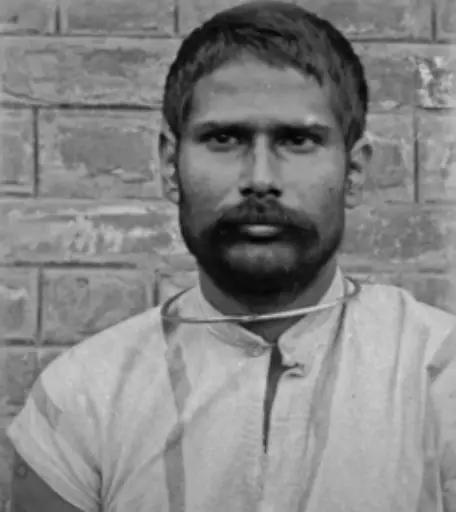
(this image is in public domain, collected from Wikipedia)
Fonder of the revolutionary group Atmonnati Samiti, Ganguly was born in Halisahar, Bengal on November 5, 1887. At a very young age he joined the revolutionary activities and became a close associate of Barindra Kumar Ghose and Rashbehari Bose. Ganguly was jailed by the British government on 24 occasions
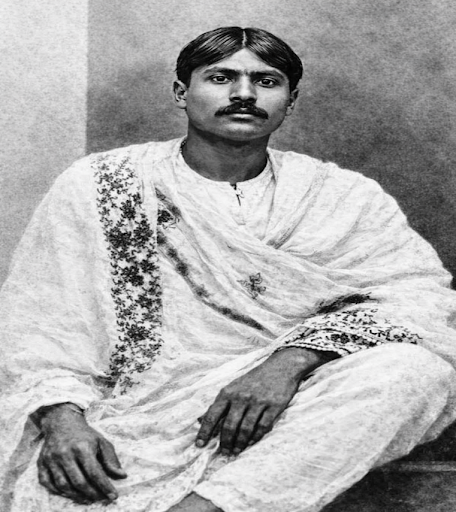
(this image is collected from Wikipedia & improved using AI)
Mitra was born in Raspur village, Amta in Howrah, Bengal, was popularly known as Habu Mitra. He joined in Anushilan Samiti and entered in British gun maker Rodda Company as an employee. British police described that Mitra was the mastermind of the famous Rodda company arms heist by the revolutionaries
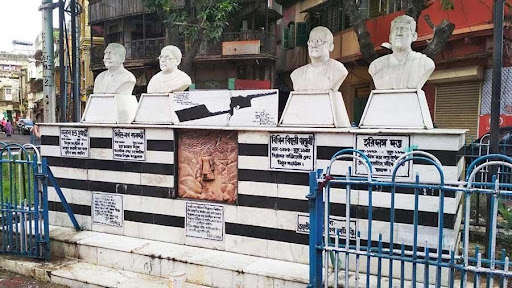
(image collected from an article published on telegraphindia.com)
2. Dacoity: There were differences among the leaders of the revolutionary groups regarding adopting the means like decoity for collecting funds for the struggle. However, later it was understood that it was needed to fund the movement. Some general guidelines or rules were accepted in these cases as, no women of the house raided must not be touched and the rich people who accumulated funds through dishonest means were to be victimised. Moreover, letters were given to these people, that after independence of India, their money will be returned.
3. Murder of government officials: The revolutionary groups kept of targeting the government officials, that included the Indian officials also who were involved in betraying their motherland:
- In 1908 Sub-inspector Nandalal Banerji was killed, who was responsible for the death of Prafulla Chaki.
- In 1908, a police informer Keshab De was killed.
- In the same year two informers from Dhaka, Annadaprosad Ghose and Sukumar Chakraborty were killed.
- In 1909, Public Prosecutor of the Alipore Bomb Case, Ashu Biswas was killed by revolutionary Charuchandra Bose.
- In 1909, Police spy from Dhaka, Birendra Ganguly was murdered.
- In 1910, Police Inspector Shamsul Alam, who received promotion and recognition for handling the Alipore Bomb Case, was shot dead.
- In 1911, Srishchandra Chakraborty of the detective department was killed in Kolkata.
- In 1911, Sub-Inspector Rajkumar Roy of the detective department was killed in Mymensingh and Police Inspector Monmohan Ghose was killed in Barisal.
- In 1912, police spy Sukumar Chakraborty was killed and Constable Ratilal Roy of the Detective Department was killed in Dhaka.
- In 1913, CID Inspector Bankimchandra Chowdhury was killed in Kolkata, police informer Birendra Biswas in Mymensingh was killed.
- In 1914, Nripendranath Ghose, police officer of the detective department was killed.
- In 1915, CID Inspector Suresh Mukherjee was killed in Kolkata.
- DSP Jatindramohan Ghose was killed in Mymensingh in 1915.
- CID officer, Girindranath Banerjee was killed in Kolkata in 1915.
- In 1916, CID officer Madhusudan Bhattacharya was killed in Kolkata.
- In 1916, police informer Upen Ghose was murdered in Kolkata, Balai Lodh, a police informer was killed.
- In 1916, CID constables Surendrabhusan Mukherjeeand Rohini Kumar Mukherjee were shot dead in Dhaka.
- In 1916, Basanta Chatterjee a police officer of the intelligence branch was killed in Kolkata.