Independence & creation of two dominions Gallery
It was the partition of Bengal in 1905 that ignited the torch of nationalism in Bengal and in rest of India to rise against the British rule and the colonial masters had to leave India in 1947. But the policy of divide and rule displayed in 1905 was ultimately responsible for the partition of India in 1947 and the birth of Pakistan.
The revolutionary organisations believed that the British rule in India was illegitimate and immoral; these organisations were for a united India and from the very beginning had a clear aim of complete independence. The foreign rulers were ruthless towards any kind of resistance and it was not inappropriate to use arms to fight them. The political murders by the revolutionary organisations were part of their war strategy against the colonial masters for waking up the country to rise against the British. Bengal played a significant role in India’s independence movement and the armed revolution from the very beginning had produced results, though the British were ruthless on every occasion to suppress the resistance.
- During the rule of British East India Company, the Sanyasi Rebellion of 1763–1820s, then Santhal Rebellion of 1855, Indigo Revolt of 1859 were instances massive resistance shown to the cruel exploitative rule of the company. The revolt of the 1857 was massive (which started in Bengal) and though crushed using heavy force but it resulted in end of the company rule and the British crown took charge of Indian administration.
- During the rule of the of the Crown, the nationalist faction of the Indian National Congress raised the aspect of complete independence from British rule and this aspect gave rise to the secret revolutionary societies in Bengal.
- The partition of Bengal on religious lines in 1905 showed the real intentions of the foreign rulers. The Swadeshi Movement and the revolutionary parties took the stage and the armed resistance by the selfless young members of the revolutionary groups and their sacrifices were able to wake up not only the people of Bengal but the whole of India.
- The sacrifices of Khudiram rouse the wave of nationalism in whole of India and even after cruel repression by the government the secret societies kept on their political attacks. As a result of the continued resistance the British govt. took the decision of withdrawing the partition of Bengal in 191l and as the political activities in Bengal impacted the whole of India, it was decided to shift India’s capital from Kolkata to Delhi.
- During the First World War, mega plans like the Hindu-German pact and the Ghadar Movement were initiated by the revolutionary groups to trigger a mutiny among the Indian men of the British Indian Army, but it failed.
- Even after supporting the British war efforts during the WW I with both men and material, Britan did not give the expected self-rule but gave us the Jallianwala Bag Massacre and enabled the detention of political suspects without trial for up to two years and restricted civil liberties to suppress nationalist movements through the infamous the Rowlatt Act in March 1919. The constitutional changes i.e. govt. of India Act of 1919 was implemented to tighten the British rule in India only.
- 1930’s showed some massive attacks which shook the foundations of the rulers. The attack at Kolkata’s Writers Building, the Chittagong uprising, bombing the national assembly on Delhi as a mark of protest.
- The Second World War again encouraged the revolutionary leaders to get the support of the anti-British forces and to wage war for the liberation of India with the Indian prisoners of war of the British Indian Army and the Indian National Army or the Azad Hind Fauj was formed.
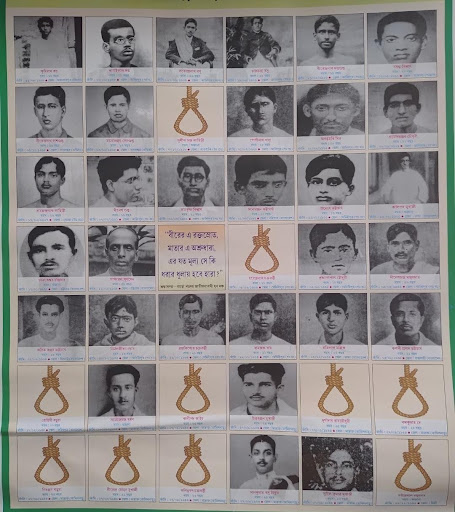
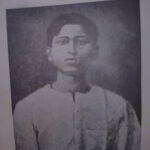
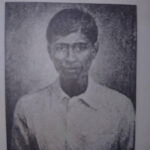
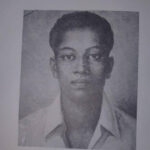
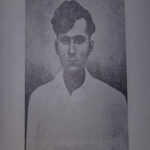
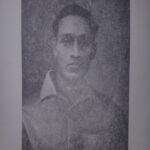
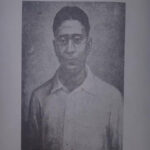
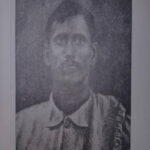
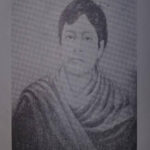
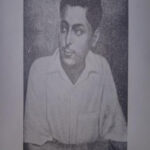
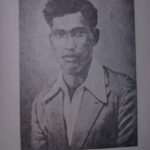
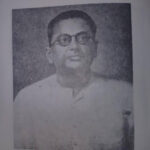
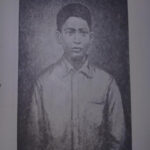
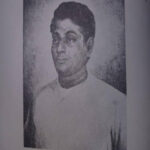
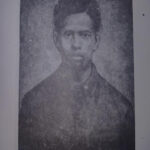
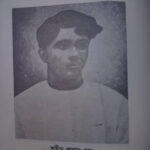
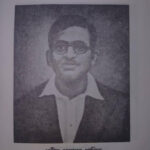
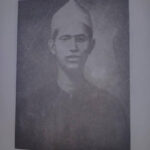
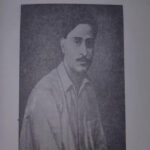
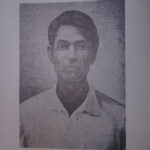
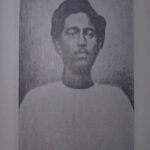
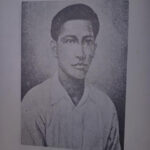
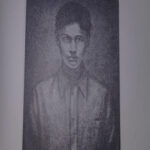
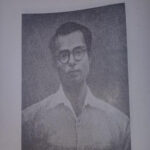
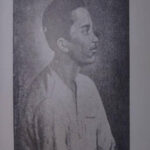
The revolutionary heroes from Bengal…executed by hanging
(image & information courtesy: Rahara Khardah Jatiyatabadi Yuva Mancha & Shri Tarun Biswas, grandnephew of revolutionary martyr Basanta Kumar Biswas)
Names of the executed revolutionaries starting from the top left side in the above image :
- Khudiram Bose, executed on 11/08/1908, at 18 years at Mujaffarpur Jail.
- Kanailal Dutta, executed on 10/11/1908, at 20 years at Alipore Jail.
- Satyendranath Basu on 21/11/1908, at 26 years at Alipore Jail.
- Charuchandra Bose on 19/03/1909, at 19 years at Alipore Jail.
- Birendranath Duttagupta on 21/02/1910, at 19 years at Alipore Jail.
- Basanta Kumar Biswas on 11/05/1915, at 20 years at Ambala Jail.
- Nirendranath Dasgupta on 03/12/1915, at 23 years at Balasore Jail.
- Namoranjan Sengupta on 03/015/1915, at 170years at Balasore Jail.
- Sushil Chandra Lahiri in 1918 (image not available).
- Gopinath Saha on 01/03/1924, at 18 years at Alipore Jail.
- Anantahari Mitra on 28/09/1926, at 20 years at Alipore Jail.
- Pramod Ranjan Choudhury on 28/09/1926, at 22 years at Alipore Jail.
- Rajendranath Lahiri on 17/12/1927, at 26 years at Gonda Jail.
- Dinesh Gupta on 07/07/1931, at 19 years at Alipore Jail.
- Ramkrishna Biswas on 04/08/1931, at 21 years at Alipore Jail.
- Manoranjan Bhattachaya on 22/08/1932, at 22 years at Barisal Jail.
- Pradyot Bhattachaya on 12/11/1933, at 19 years at Mindapore Jail.
- Kalipada Mukherjee on 16/02/1933 at Dhaka Jail.
- Tarakeswar Dastidar on 12/01/1934 at Chittagong Jail.
- Masterda Surya Sen on 12/01/1934, at 39 years at Chittagong Jail.
- Harendranath Chakraborty in June 1934, at 18 years at Midnapore Jail (image not available).
- Krishna Gopal Choudhury in June 1934, at 20 years at Midnapore Jail.
- Dinesh Chandra Majumdar on 09/06/1934, at 27 years at Alipore Jail.
- Asit Ranjan Bhattacharya on 02/07/1934, at 19 years at Sylhet Jail.
- Nirmal Jeeban Ghosh on 26/10/1934, at 18 years at Midnapore Jail.
- Brajakishore Chakraborty on 26/10/1934, at 21 years at Midnapore Jail.
- Ramkrishna Roy on 26/10/1934, at 22 years at Midnapore Jail.
- Motilal Mallik in December 1934, at 22 years at Dhaka Jail.
- Bhabani Prasad Bhattacharya on 03/02/1935, at 21 years at Rajshahi Jail.
- Rohini Barua on 18/12/1935, at 20 years at Faridpur Jail (image is not available).
- Satyendra Chandra Bardhan on 10/09/1943, at Madras Jail.
- Kalipada Aich on 27/09/1943, at 23 years, at Madras Jail (image not available).
- Chitta Ranjan Mukherjee on 27/09/1943, at 24 years, at Madras Jail.
- Durgadas Roy Choudhury on 27/09/1943, at 25 years, at Madras Jail (image not available).
- Nanda Kumar Dey on 27/09/1943, at 25 years, at Madras Jail (image not available).
- Niranjan Barua on 27/09/1943, at 23 years, at Madras Jail (image not available).
- Nirendra Mohan Mukherjee on 27/09/1943, at 21 years, at Madras Jail (image not available).
- Fani Bhushan Chakraborty on 27/09/1943, at 23 years, at Madras Jail (image not available).
- Mankumar Basu Thakur on 27/09/1943, at 23 years, at Madras Jail.
- Sunil Kumar Mukherjee on 27/09/1943, at 22 years, at Madras Jail.
- Satindra Lal Majumdar on 24/11/1988, at 23 years, in Delhi (image not available).
Revolutionary martyrs from Bengal
(these images are collected from the book ‘Mrityunjayi’ published by Information and Culture Department, Govt. of West Bengal)
The Historic INA Trials
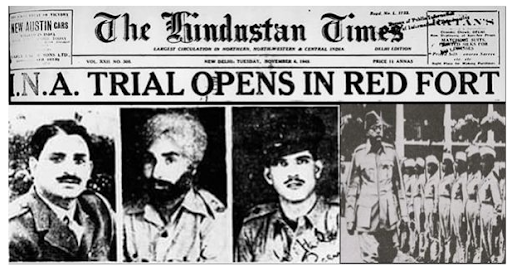
After the end of the war to captured INA men were put to trial by the British and plot was to humiliate the INA and their efforts. This trial, organised at the Redford in November 1945, had accused the INA men of charges of waging war against the British crown, treason and murder. The Indian National Congress, which was distancing itself from Netaji Subhas Chandra Bose and the INA during the war, had now declared its support to the captured INA men and made it the biggest issue in the elections of 1946. The committee formed for the defence of INA soldiers was formed by Congress Working Committee, it included Jawaharllal Nehru, Bhulabhai Desai, Asaf Ali, Tej Bahadur Sapru and Kailash Nath Katju. Bhulabhai Desai played the vital role in defending the INA men.
Initially, over 7,600 members of INA were set for trial but due to difficulty in proving their crimes the numbers of trials were significantly reduced. Approximately ten courts-martial were held, the first of these was the joint court-martial of Colonel Prem Sahgal, Colonel Gurbaksh Singh Dhillon and Major-General Shah Nawaz Khan. The three had been officers in the British Indian Army before joining the INA. The three came to be the only defendants in the trials who were charged with “waging war against the King-Emperor”.
The news and the broadcasts about anti- British activities of Netaji in Japan and Southeast Asia during the war were censored in India and the British government spread the propaganda news in India that Japan was trying to invade India and Netaji was helping them with his army of Indian prisoners of war. But as the INA Trial proceedings were covered by the press in India, the people got to know that under the leadership of Netaji Subhas Chandra Bose, the Indian National Army was fighting alongside Japan for the liberation of India and INA was a selfless, revolutionary army who did not fight for any salary or benefits but to free their motherland. Anger irrupted in all the important cities of India, as the INA men were then regarded as national heroes, even the Indian army men started observing ‘INA Day’, ‘Subhas Week’ to show support the INA men. This had also fuelled a massive revolt in the Royal Indian Navy in February 1946.
The three officers could successfully defend them and the defence council particularly Bhulabhai Desai was successful in proving that the INA was fighting for India’s freedom and it was under a legitimate, formally created government and Japan was helping the Azad Hind Govt. as an ally in the war. The British authorities were about to either execute the officers or deport them for life imprisonment, however, due to the arguments presented in the court proceedings and the nationwide outrage, the authorities had to ultimately release the INA men.
Azad Hind Govt. functioned independently & Japan was an ally
Members of the defence counsel put before the court some important high rank dignitaries of the Japanese Govt. (who were in power during the war):
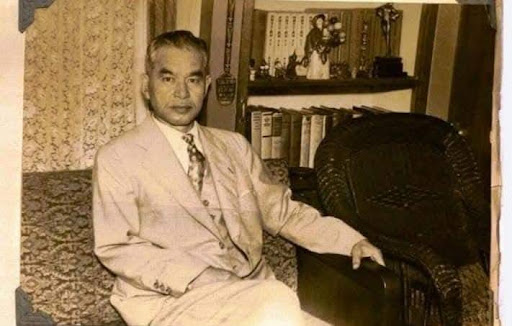
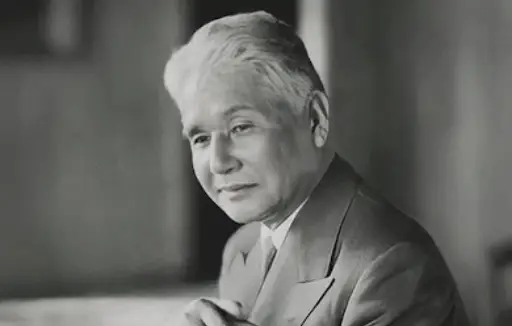
Mr. Teruo Hachiya was the Japanese Minister accredited to the Provisional Govt. of Azad Hind. His statement showed how independent was Netaji in running the affairs of his govt. Mr. Hachiya disclosed that when he reported at Rangoon, Netaji refused to see him because he did not bring his credentials. Hachiya was obliged to send a telegraphic message to Tokyo and his govt. despatched credentials duly signed by the Emperor of Japan. Mr. Hachiya’s statement was verified by Mr. Renzo Sawada who was Vice Minister of Foreign Affairs from October 1944 to May 1945. Cross examined by the prosecution counsel, Mr. Sawada gave full details of the Hachiya episode.
Japanese Vice Minister Mr. Shunichi Matsumato and foreign office official Mr. Saburo Ohta confirmed about the proclamation of the provisional govt. and its recognition by various govt.s.
Major General Tudashi Katakura gave testimony that as per the proclamations for the military operations by the Japanese forces and the provisional govt. was that, the Japanese soldiers would attack only the Britishers and not the Indians and the captured Indian territories would be handed over to the provisional govt. of free India.
(Information & image courtesy: Shubham Sharma)
The last nail on the British Raj’s coffin
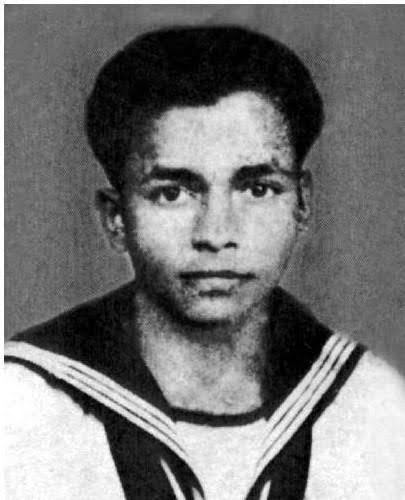
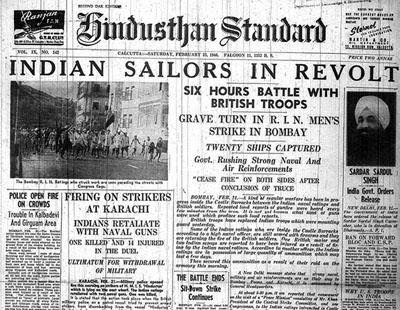
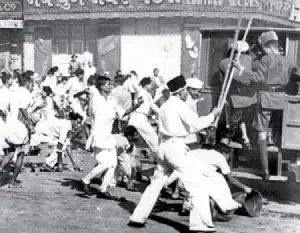
The 1946 Royal Indian Navy (RIN) Mutiny was a pivotal, large-scale revolt against British colonial rule, beginning on February 18, 1946, aboard HMIS Talwar in Bombay (Mumbai). Sparked by poor food, racism, low pay and inspired by the Indian National Army (INA) trials, over 20,000 sailors from 78 ships and 20 shore establishments in Mumbai, Kolkata, Madras (Chennai) and Karachi joined in. The leader of the mutiny was a brave nationalist sailor from Bengal, B.C Dutt. Dutt was arrested as he wrote on the walls of HMIS Talwar, ‘Quit India’, ‘Jai Hind’. This was not a mutiny for seeking good quality food, higher pay, it was clearly a revolutionary, nationalist fight rejecting the British rule and asking them to leave India.
(image collected from Wikipedia. By Nikrocks12345 – Own work, CC0, https://commons.wikimedia.org/w/index.php?curid=162942735)
Leading figure of the 1946 Naval Mutiny, B.C Dutt was born in Bardhaman district of Bengal. Dutt played a significant role in the 1946 mutiny, the mutiny contributed greatly in India’s independence
Mutineers formed the Naval Central Strike Committee, held up portraits of Netaji Subhas Chandra Bose, chanting Netaji’s name and INA slogans. They hoisted Congress, Muslim League, and Communist party flags on ships. The agitation saw intense fighting in Bombay, where civilian workers and students joined the mutineers in protests. The revolt highlighted the breakdown of discipline in the Indian military, considered the backbone of British rule. Even while the Congress and Muslim League advised the sailors to stop, the uprising illustrated that the Indian armed forces’ loyalty to the British was over.
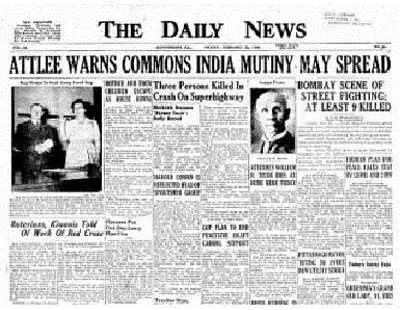
The rebellion was suppressed with force, resulting in over 200 deaths and 1,000 injured, leading to the dismissal of 476 sailors. However, it acted as a major catalyst for independence, the declassified secret documents of ‘Transfer of Power, volume VI’ clearly shows reports and communications about the erosion of loyalty among the Indian armed forces and fear of a massive revolt due to the situations created by the INA trials and the navel mutiny. The volume VI shows, Indian Viceroy’s communication to the British Crown and to the Prime Minister urging to take quick decision about independence of India and other related communications and minutes on Indian independence approved by Prime Minister Attlee in March 1946, says it all.
(image courtesy https://frontierweekly.com/)
(spread (image courtesy https://frontierweekly.com/)
(image courtesy https://frontierweekly.com/)
The British Govt. Secret Documents on Indian Independence
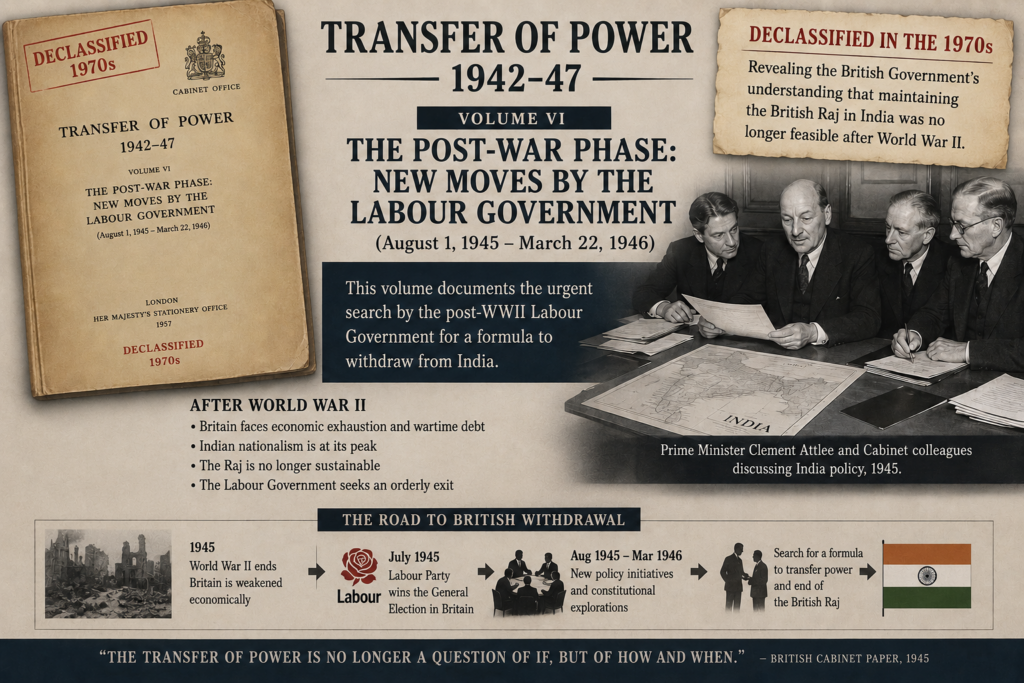
(AI generated image depicting how British government took the decision to leave India after WW II)
Declassified in 1970’s, Volume VI of the Transfer of Power 1942–47, titled “The Post-War Phase: New Moves by the Labour Government” (August 1, 1945–March 22, 1946), is significant for detailing the British shift toward rapid withdrawal from India following WW II. It documents the post-WWII Labour Party government’s understanding that maintaining the British Raj was no longer feasible, documenting the urgent search for a formula to exit India.
- Page 512 of the volume VI of the ‘Transfer of Power’ shows a significant secret communication by the Intelligence Bureau’s report on INA Trials on November 20, 1945. Which stated about the wide spread support in India for the INA men and anti-British wave in the entire nation, the nationalist press covering the news of the trail, observation of INA Day, INA Weeks by the people.
- Pages 542, 546, 631, 724, 807 shows communications from Governors of provinces like Bengal, Punjab, Madras writing to the Viceroy Viscount Wavell stating about the unrests and protests in their respective provinces against the ongoing INA Trials.
- Pages 530, 939 shows communication from army chief General Auchinleck to the Viceroy on November 24, 1945, that states about the ongoing INA Trials and the public reactions and he states about dropping some of the charges in the trials, the public outrage about the trials gave an excellent election cry to the Congress party, the aspect of questioning the reliability of the Indian Armed forces.
- Page 552 shows letter from Viceroy Wavell to Secretary of State for India in London Pethik Lawrence on November 27, 1945, states about the disburbing political situation in India, tensions between Congress and Muslim League and its demand for Pakistan or partition of India (excluding the Muslim dominated areas from India), people’s reaction about the INA Trials, demands to release of the INA officers were growing, the British govt. was threatened from the public meetings that if the INA men were not released, then massive revolt would take place, In Delhi large posters were seen written in red ink that ‘twenty English dogs’ for every INA man executed’, there were reports about starting a guerrilla warfare for the release of the INA men, the situation might lead to damaging the moral of the Indian army men deployed in Southeast Asia and seeking their withdrawal.
- Pages 576, 638, 673, 675, 975 shows reports by General Auchinleck to chiefs of staff committee on December 1945, which states about possible communal trouble in India, peoples’ reaction about INA Trials, Congress’s election campaign raising the INA issue, preparations to deal with a well-organized revolution and doubt about trusting the Indian Armed Forces, Congress and other bodies may intensify their anti-British campaign, General Auchinleck requested for send British troops to India to suppress any unrest and the situation in India was delicate, stress given in maintaining the reliability of the Indian Armed Forces.
- Pages 713, 1054, on December 1945 and February 1946, shows communication from Indian Viceroy to the British Crown and Prime Minister on December 31, 1945, states about tense political situation as the Congress in campaigning stating INA men as martyrs, serious rioting in Kolkata as students protested on INA Trials, the protests in Kolkata was massive as 33 people died, 200 police men injured and many vehicles destroyed. An agreement between the Congress and the Muslim League to be reached somehow and avoid upheaval. Letter to PM addressed the situation regarding the Royal Indian Naval Mutiny and the disturbances caused in Mumbai, Kolkata and in other Indian cities.
- Pages 1071, 1079 about the communications from the Governors of to the Viceroy regarding the serious situation created due to the naval mutiny.
- Pages 1106, 1107, 1108 communication Secretary of State for India Lawrence to Prime Minister Attlee (March 4, 1946) regarding settlement of the Indian situation, i.e. about independence of India and preparations being made for settlement of the Indian issues as it would not remain within the Empire and King to be informed about that. On March 5, 1946 minute approved by PM Attlee states that the King had been informed about giving freedom to India and he did not dissent.
- This is how the British Prime Minister Clement Attlee officially agreed to the proposal of India’s freedom and the impact of the INA Trials and the mutiny in the Royal Indian Navy is very much evident in making the British government bound to take such a decision in the post-world-war situation.
Source: Book by Dr. Kalyan Kumar De
NETAJI: India’s Independence and British Archives
Independence and Partition of India
After the publication of the news related to the fact of the struggle of the Azad Hind Fauj or the INA led by Netaji, massive agitations started in major cities across India, Kolkata saw big riots and students got killed in police firings. This exerted extreme pressure in London and on December 4, 1945, the Secretary of State for India declared about the visit of a Parliamentary Delegation to visit India soon to discuss about the independence of India.
The delegation reached India in January 5, 1946 and held discussions for one month with Muslim League and the Congress. Mohammad Ali Jinnah emphasized on creation of Pakistan but nothing conclusive happened and the designation returned. Viceroy on January 28, 1946 declared about forming executive council to frame new constitution.
On February 18, the Naval Mutiny started and on the next day British PM announced about visit of a Cabinet Mission in India for final discussion on framing the news constitution. The mission reached Indian on March 24, 1946 and held discussion with the Congress and the Muslim League, the league asked for Pakistan but Congress was not ready to accept it and ultimately the mission retuned with no consensus. But it proposed the structure of future independent India as:
- A federal state (including British India & native states)
- The union will be in charge of foreign affairs, defense and communication
- Other subjects will be taken care by the provinces and native states
- Further, constitution to be framed by participating in the Viceroy’s Executive Council
Both the Congress and the League could not be brought together to frame the constitution. The Congress participated in the first meeting of the Constituent Assembly on December 9, 1946 and the proceedings started without the Muslim League. On February 20, 1947, British government declared about granting independence to India by June 1948, it was a matter of great joy for India as a whole but it did not please the league. On August 16, Muslim League declared ‘Direct Action Day’, which caused horrific riots took place in Kolkata, Noakhali, Punjab and creation of Pakistan, a separate nation for Muslims by partitioning India became inhabitable.
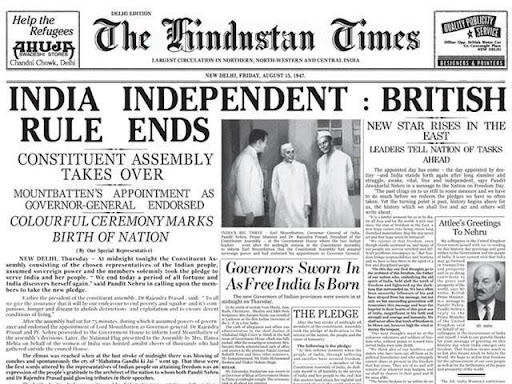
On August 14, the dominion of Pakistan was created with the Muslim majority areas including western part of Punjab, North West Provinces, Sindh, Baluchistan in the west and Eastern part of Bengal and Sylhet in the east and rest of India became the Indian dominion on August 15. After implementation of the constitution in 1950, India became a republic. Independence of India was a result of the struggle and sacrifices made by the freedom fighters, both the non-violent struggle of the Congress, mainly led by Mahatma Gandhi and the armed struggle by the revolutionaries played vital roles in liberating India.
The nationalist section of the Congress and the brave nationalist revolutionaries from the very beginning had clear aim of achieving complete independence. Political attacks by the revolutionaries and the articles in the revolutionary newspapers like Bande Mataram, Jugantar played effective roles in growing consciousness among the masses to oppose the foreign rule. Bengal and its activists, revolutionaries, its writers, poets played a great role in making India free. The jails in India or in Burma where the brave souls were executed or tortured will remain the witness of their selfless sacrifices to liberate our motherland. The efforts of the revolutionaries starting from the formation of Anushilan Samiti and Jugantar, formation of IIL by Rashbehari Bose, Netaji Subhas Chandra Bose leading the INA till the mutiny of the Royal Indian Navy paved the way for independence. But we could not get the united India of Netaji’s and India got partitioned.
British Prime Minister…on India’s independence
The framer of the Indian constitution, Dr. B.R Ambedkar in his interview to BBC in 1955 expressed his opinion about the reasons for India getting independence in 1947. He said, as per his assessment, Britain was ruling India only the basis of the Indian Armed Forces and they believed, whatever the politicians do, they would never be able to change the loyalty of armed forces. But this aspect dashed to pieces due to the national army led by Netaji Subhas Chandra Bose and a situation of revolt like 1857 could no more be managed by Britain by supplying European soldiers to India, so Britan left India.
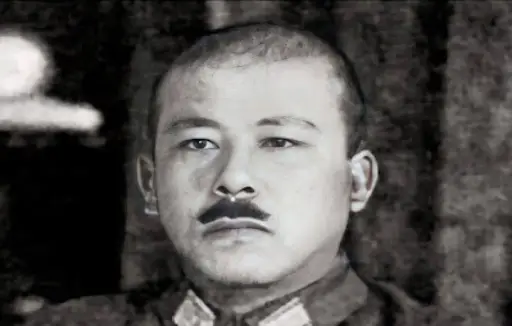
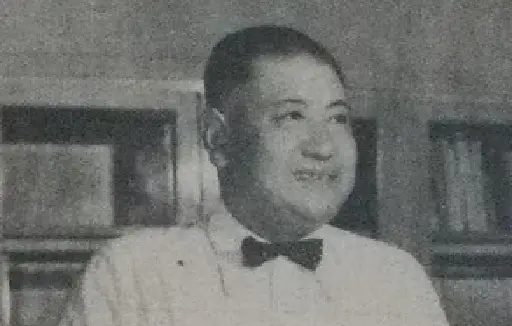
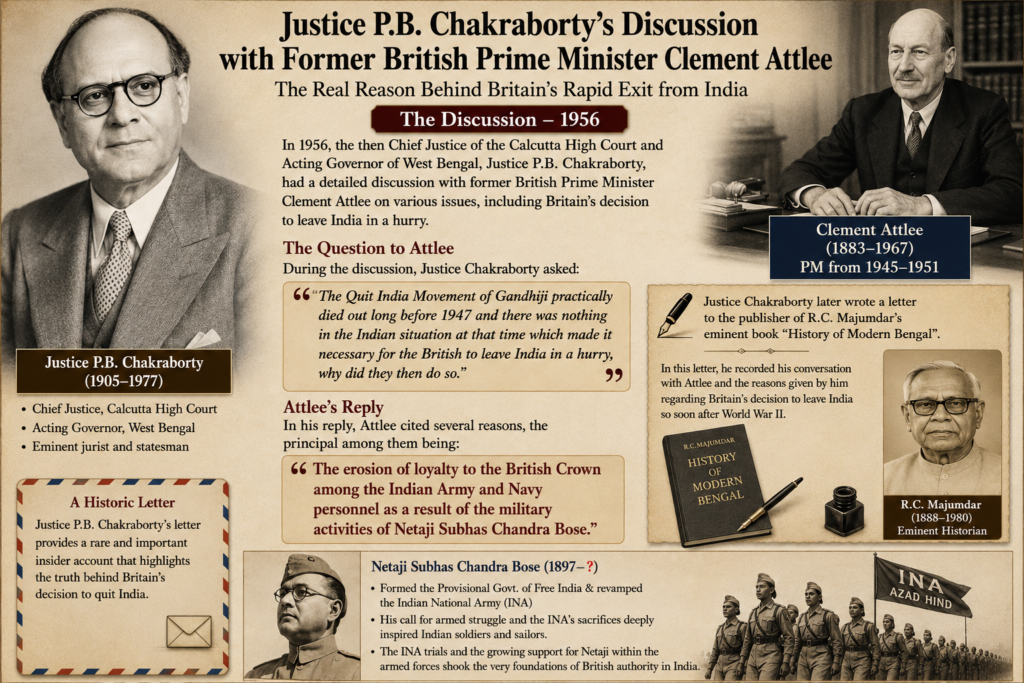
The assessment of Dr. Ambedkar was proved to be correct when Clement Attlee visited India in 1956, when the former British Prime Minister (during his tenure India
became independent) stayed at the Governor House in Kolkata. The then Chief Justice of the Calcutta High Court Justice P.B Chakraborty, who was also the acting Governor for the state of West Bengal, had some detailed discussions with the British Prime Minister on various issues. Justice Chakraborty later wrote a letter to the publisher of the eminent historian R.C Majumdar’s book “History of Modern Bengal”. In this letter he stated that he asked Attlee “the Quit Indian Movement of Gandhiji practically died out long before 1947 and there was nothing in the Indian situation at that time which made it necessary for the British to leave India in a hurry, why did they then do so.’ Chakraborty added “In his reply Attlee cited several reasons, the principal among them being the erosion of loyalty to the British crown among the Indian army and Navy personnel as a result of the military activities of Netaji Subhas Chandra Bose.”
Declassified documents of the ‘Transfer of Power’ volume VI clearly proves that what Clement Attlee claimed was right, as per the secret communications by the British officials both in India and in London in the post WW II scenario to grant independence to India.
{AI generated image depicting West Bengal Governor Justice P.B Chakraborty having a discussion with former British Prime Minister Clement Attlee in Kolkata Raj Bhavan (now Lok Bhavan) in 1956}