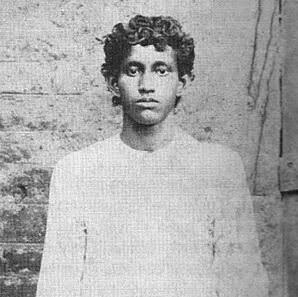
Barely eighteen, with dreams still unformed and life just beginning, Khudiram Bose walked to the gallows with a smile that stunned the British and awakened a nation. He did not tremble, did not plead, did not look back. Instead, he carried in his young heart the unshakable belief that India was worth more than his own life. For him, freedom was not a distant ideal—it was a sacred duty.
Born in Bengal’s soil of resistance, Khudiram embodied fearless patriotism. His sacrifice sent a surge through India’s veins; songs were sung in his name, mothers named their sons after him, and revolution found a youthful face. The rope that silenced his breath could not silence his spirit—his martyrdom echoed in every cry of Vande Mataram.
Attempt to assassinate Kingsford
On May 2, 1908, The Statesman reported “The Railway station was crowded to see the boy. A mere boy of 18 or 19 years old, who looked quite determined. He came out of a first class compartment and walked to the phaeton, kept for him outside, like a cheerful boy who knows no anxiety… on taking his seat the boy lustily cried Bande Mataram”.
The newspaper here describes about the news of bringing Khudiram Bose to Muzaffarpur after his arrest
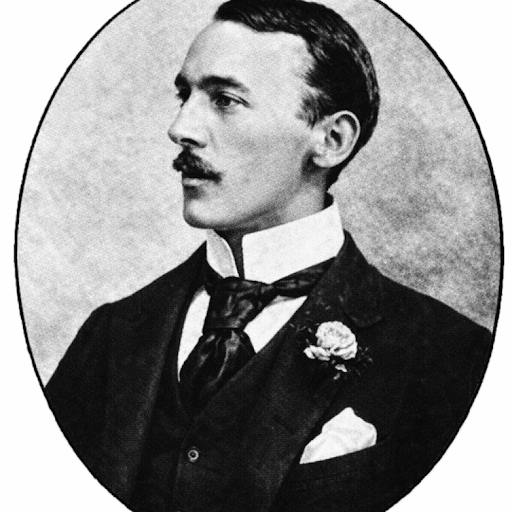
The Chief Presidency Magistrate of Kolkata was Douglas Kisgford, who was infamous for awarding harshest possible sentences to the so called political offenders.
The Jugantar Party decided to assassinate Kingford. Fearing an attack, he was transferred to Bihar’s Muzaffarpur.
Revolutionary Prafulla Chaki from Rangpur (present-day Bangladesh) and young Khudiram Bose from Midnapore were given the responsibility to assassinate Kingsford at Muzaffarpur. Ullaskar Dutta made the bombs to be thrown at Kingsford.
After reaching Muzaffarpur, as per plan, they kept a close watch on Kingsford for several days to work out his daily routine.
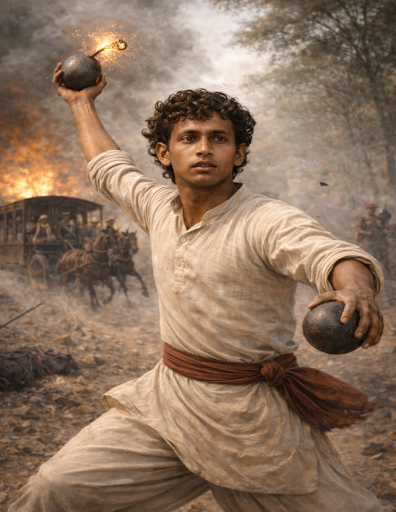
On April 30, 1908, in the evening Kingsford was returning home from the club in a carriage, in a similar carriage wife and daughter of lawyer Mr. Kannedy arrived from the same club near Kingsford’s home. Wrongly considering the carriage to be of Kingsford, Khudiram threw a bomb at the same, which took Mrs. and Miss Kannedy’s lives.
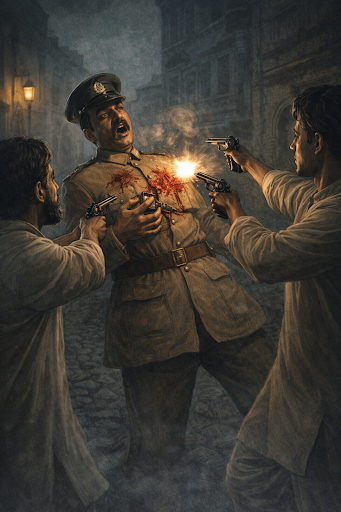
AI generated image depicting Khudiram Bose throwing a bomb
Magistrate Douglas Kingsford
Image collected from Wikimedia Commons (improved using AI for better presentation)
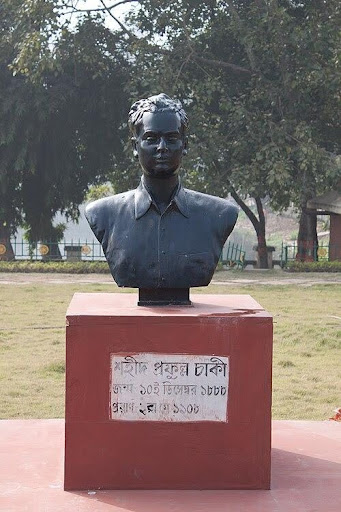
Image of half bust of Martyr Prafulla Chaki
Indian revolutionary freedom fighter, born on 10 December 1888 in Bogra district of present-day Bangladesh. Prafulla was associated with the Jugantar Party of revolutionaries. He came in contact with revolutionaries while studying in Rangpur National School and Barindra Kumar Ghose brought Prafulla to Kolkata, enlisted him in the Juganta Party
(collected from Wikimedia Commons)
Arrest of Khudiram
Both Prafulla and Khudiram managed to escape thinking that they were able to kill Kingsford.
The police put out a widespread alert, with instructions to arrest any suspicious young Bengalis and offered a reward of Rs.5000/- for information.
Prafulla took a train and reached Mokamaghat station, where police Sub-Inspector Nandalal Banerji attempted to arrest him on suspicion.
To avoid arrest Prafulla Chaki killed himself with his own revolver and attained martyrdom on May 2, 1908.
Khudiram took another way to escape; Khudiram Bose walked miles along the railway line through the night without food or drink and arrived the next morning, tired and exhausted, at the small town of Waini in Bihar.
As hungry Khudiram stopped at a shop to eat something, where he heard people speaking about the bomb blast and killing of Mrs. and Miss Kennedy and not Kingsford.
Khudiram reacted and expressed astonishment and spoke in Bangla, saying “what, Kingsford is not killed!!”.
The policemen present there arrested Khudiram on suspicion.
Court Trial and Martyrdom
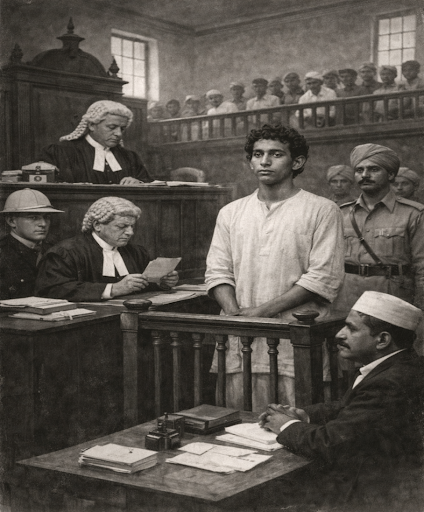
AI image, depicting Khudiram Bose during the court proceeding at Mujaffarpur
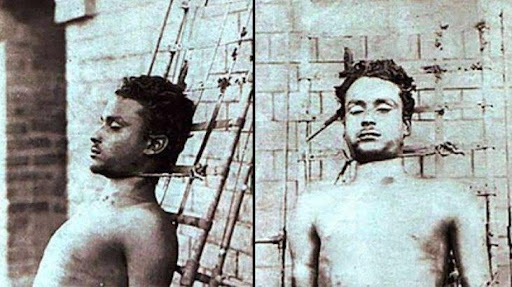
After the death of Prafulla, the police ruthlessly beheaded his body, packed his head and sent it to Kolkata for identification. A few days later the C.I.D. could establish the identity of Prafulla Chaki of Rangpur.
On the other hand, after the arrest of Khudiram, in his statement before the District Magistrate, he said that he had intended to kill Kingsford as he looked upon the him as the greatest tyrant in India and that he threw the bomb on the carriage on April 30, in the belief that it had been carrying Kingsford and not two innocent and unfortunate ladies.
The trial commenced on June 8, 1908 and Khudiram pleaded guilty. The case ended on June 13 with a death verdict. When the Judge declaring the verdict enquired whether Khudiram had understood the implication of the sentence passed on him, the young revolutionary nodded and smiled. His face brightened up, as he had nothing to do with it.
To a question by the lawyer Khudiram replied that he had no cause of fear. He had read the Gita perfectly well. There was no question of his pleading not guilty as he felt fully conscious of his responsibility in the matter and he was sorry that Kingsford was still alive and that two innocent ladies had been killed instead.
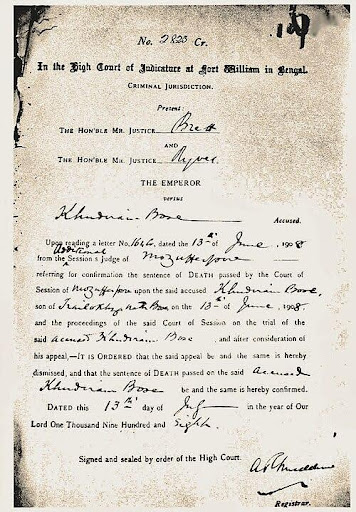
An appeal was made in the High Court on July 6, 1908 against the death penalty. However, after a short hearing the sentence of death by hanging was confirmed on July 13, 1908.
Khudiram Bose walked to the gallows firmly and cheerfully and even smiled when the cap was drawn over the head.
And, finally on August 11, 1908, Khudiram’s execution took place at 6 AM in the Muzaffarpore Jail.
Images of the dead body of Prafulla Chaki, probably before beheading his body (collected from Facebook)
Empire’s Verdict: Death for Young Khudiram
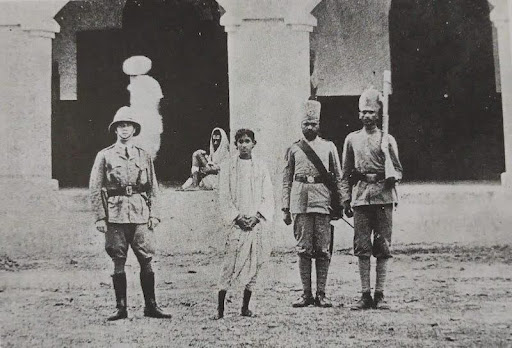
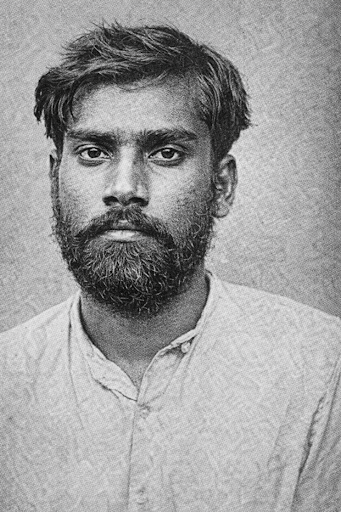
Khudiram Bose at the Mujaffarpur Jail
(this image is in public domain, collected from Wikipedia)
After Khudiram’s martyrdom The Empire on August 12, 1908 reported “Khudiram Bose was executed this morning… It is alleged that he mounted the scaffold with his body erect. He was cheerful and smiling.’
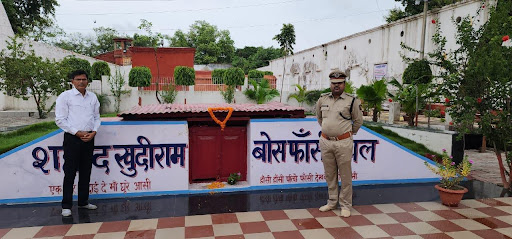
The exact place of hanging of Khudiram Bose, decorated by the jail authority after independence of India The Mujaffarpur Jail is also renamed as ‘Shahid Khudiram Bose Central Jail, Mujaffarpur’
Image courtesy: Dainik Jagaran
Death Sentence of Khudiram Bose, a historic document
Blood for Blood: Revenge for Prafulla’s Death Finally Taken
The revolutionaries of Bengal were aware about the fact that Sub-Inspector Nandalal Banerji was responsible for young Prafulla Chaki’s death and Banerji received appreciation, money and promotion from the colonial government. Secret meetings were held within the ranks of Mukti Sangha and Atmonnati Samiti, a daring decision was taken — the tyrant would face justice. The mission was entrusted to two determined sons of the motherland: Srish Chandra Pal and Ranendranath Ganguly. They accepted the task not as an act of revenge alone, but as a sacred duty to the nation. On November 9, 1908, the blow was struck, Swift. Silent. Surgical.
Nandalal Banerji was eliminated in an operation so meticulously planned and flawlessly executed that the British police machinery was left baffled. The colonial government, despite all its power and intelligence networks, could never uncover the truth behind the assassination — not until India finally broke her chains of slavery. It was not merely a killing, it was a message. The message was clear: the blood of India’s martyrs would never go unanswered.
Revolutionary Srish Chandra Pal
(image is in public domain, collected from Wikipedia & improved using AI)
A member of the Dhaka-based Mukti Sangha (later known as Bengal Volunteers). Pal was a follower of Netaji Subhas Chandra Bose. He played a central role in planning and executing the famous Rodda Company Arms Robbery in August 1914. Which involved stealing 50 Mauser pistols and 46,000 cartridges from Rodda & Co., a British arms dealer in Kolkata, to boost the anti-British armed revolution
An imaginary image of killing of Sub-Inspector Nandalal Banerji (AI generated)
How Prafulla & Khudiram ignited the nation
The bomb thrown by Prafulla and Khudiram exploded in Mujaffarpur but its sound echoed not only throughout Bengal but all over India. And, the nation roused from its morass of lethargy.
Khudidam was the first Indian freedom fighter to be executed by the British government and the fearless young revolutionary became a household name in all over India.
Nationalist leader Bal Gangadhar Tilak, in his newspaper Kesari, defended and lauded the two young men and called for immediate swaraj (independence). This was followed by the immediate arrest of Tilak by the colonial government on charges of sedition.
After martyrdom, Khudiram became so popular that weavers of Bengal started weaving a special type of dhoti, with ‘Khudiram’ written on its side. People wearing these dhotis openly expressed their solidarity with Khudiram’s sacrifice and paid homage to the revolutionary.
“Ekbar biday de Ma ghure ashi“ (Bid me farewell once Mother, I will be back soon) is a Bengali patriotic song written by Pitambar Das, was composed in honour of Khudiram Bose. This song is still very popular in Bengal
The song “Ekbar biday de Ma ghure ashi” in Bengali script
English translation of the song Bid me farewell once mother, I will be back soon. Whole of India will watch me while I wear the noose smiling
With me I had a bomb I'd made Waiting by the roadside O Mother Trying to kill the Governor, Killed some other Englishmen Had I had a dagger on me You think they could have caught me? Would have made a blood bath And the world would have watched that On Saturday morning after 10AM
The Judge Court Road will be packed with people O Mother
Abhiram was deported to an island, Khudiram will hang by the neck 12 lakhs and 33 crores
Is the number of sons and daughters you will still have left O Mother
Build your family around them Make them your servants 10 months and 10 days from now I shall be born to my maternal aunt O Mother
If you don’t recognize me
Look for the mark of strangulation (from the noose) around my neck.
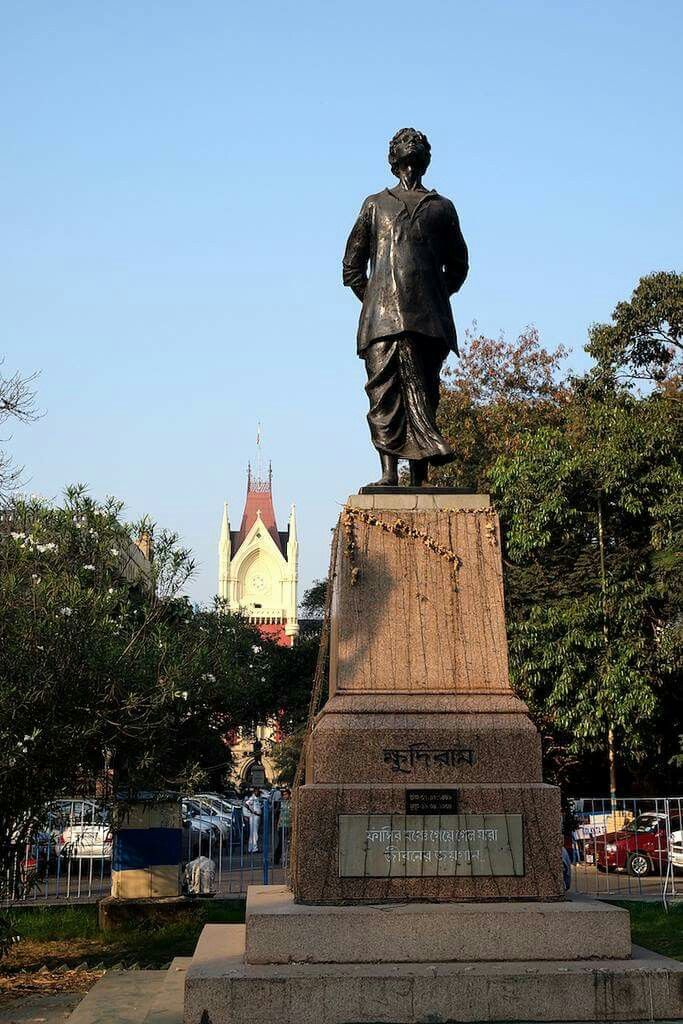
Statue of Khudiram Bose near the High Court in Kolkata
(Image courtesy: Facebook)
Born on December 3, 1889, in the quiet village of Mohbani in Midnapore district of Bengal, Khudiram Bose entered a world that would soon test his courage and shape his destiny. Fate dealt him sorrow early in life, he lost his mother at the tender age of six and his father followed her a year later. Orphaned in childhood, he found shelter and affection in the home of his elder sister at Hatgachha village, where he continued his education at Hamilton High School.
Even as a teenager, his heart beat with an intense love for his motherland. The political atmosphere of Bengal was charged with the spirit of resistance, and young Khudiram was deeply moved when he listened to the stirring speeches delivered in Medinipur by Sri Aurobindo and Sister Nivedita. Their words did not merely inspire him and awakened him.
Khudiram chose the path of sacrifice. Barely fifteen, he joined the ranks of volunteers committed to freeing India from colonial rule. Fearless and determined, he distributed anti-British pamphlets, openly defying the empire. His first arrest came not as a setback but as a badge of honor — proof that even in his youth, he had resolved to dedicate his life to the nation.
Khudiram Bose was a symbol of youthful courage, a flame that burned brightly and fearlessly for India’s freedom. Both Khudiram and Prafulla Chaki were responsible for igniting the spirit of nationalism in India to oppose the colonial rule in such a massive scale for the first time in Indian history.
Vande Mataram…
A video of the village where Khudiram was born (courtesy: theviewsexpress.in)