Anushilan-Jugantar Gallery
(this image is in public domain, collected from Wikipedia)
The Anushilan Samiti and the Jugantar Party played a decisive role in introducing organised revolutionary nationalism into India’s freedom struggle. Anushilan Samiti created a disciplined network of politically conscious youth through physical training and nationalist ideology, laying the foundation for armed resistance against British rule. The Jugantar Party, emerging from Anushilan Samiti, took this movement forward through direct revolutionary action, challenging colonial authority and breaking the myth of British invincibility. Their activities inspired fear among the rulers and confidence among the masses, influencing the broader national movement. Together, they kept the spirit of resistance alive during periods of political repression and significantly shaped the revolutionary tradition in India’s struggle for independence.
“Non-co-operation” as mark of protest
The Swadeshi Movement after the partition of Bengal in 1905 in real sense created the foundation for a nationalist movement throughout India against the British Empire. The Indian National Congress established in 1885 mainly to represent the Indians in British India, by 1905, saw political differences among its important leaders. The major two groups created were the moderates and the Extremists or the Nationalists. The new party had leaders like Bipin Chandra Pal, Lala Lajpat Rai, Bal Gangadhar Tilak, Aurobindo Ghose. The moderates aimed at attaining a dominion status or self-governance under the British Monarch like Canada, Australia, whereas the Nationalists were for complete independence. The new party of the Extremists or Nationalists came-up with a policy of passive resistance, as Bal Gangadhar Tilak stated “ we shall appeal but at the same time we shall see that the appeal is heeded”. It was Bipen Chandra Pal and Aurobindo Ghose who introduced the concept of ‘non-co-operation’ as a mark of protest against the British government.
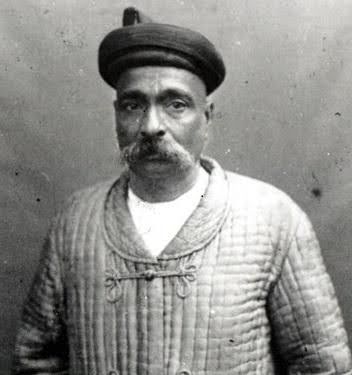
Image courtesy: RC Majumdar’s book History of Modern Bengal
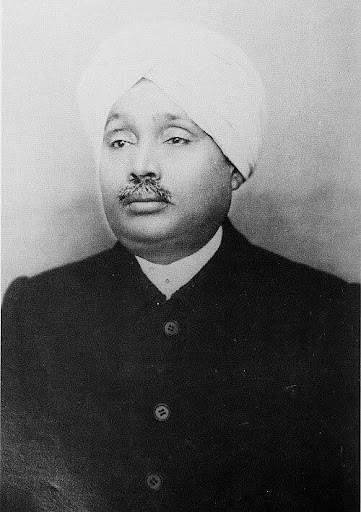
(this image is in public domain, collected from Wikipedia)
Known as Punjab Kesri. Rai was an eminent nationalist leader, he died of severe injuries sustained in 1928 during a baton charge by police in Lahore, when he led a peaceful protest march against the Simon Commission
Nationalists on the role
In July 31, 1909, Aurobino Ghose wrote in the journal Karmayogin titled “An open letter to mycountrymen” explains the aims of the Extremists or Nationalists:
“The object of passive resistance is two-fold- education in self-reliance and putting pressure on the
government. The essence of the policy aims at denial of co-operation to the government so long as
the people are denied the right to make their laws and getting control of the economic policy and
the administration of the country. When the Americans started their agitations against Bratain, their
battle cry envisaged ‘No taxation without representation (in administration)’. Similarly we shall
demand ‘Control over administration or else non-co-operation’. Boycott means non-co-operation in
economic exploration, education, administration of justice and in all governmental activities”.
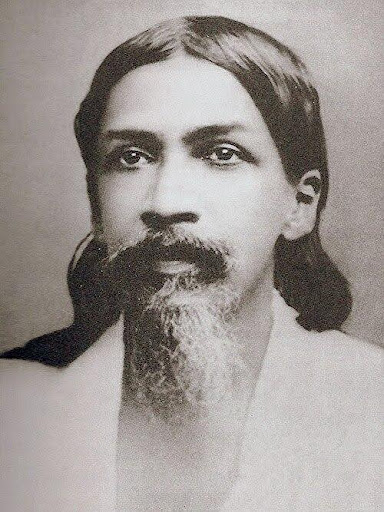
(this image is in public domain, collected from Wikipedia)
Indian nationalist leader, revolutionary freedom fighter, one of the founders of revolutionary organization Anushilan Samiti. Later, Ghose devoted himself to spiritual practice, eventually formulating the path of Integral Yoga
Bipin Chandra Pal played a major role in shaping the roadmap of the Nationalist Party with his strong
anti-British writings and lectures. In a meeting in Madras (present day Chennai) in 1907 Bipin
Chandra Pal stated that, “Indians might be appointed to high offices, as High Court judges, as
members of the Legislative Assemblies and of the Viceroy’s Executive Council and the Indian Civil
Service may be manned entirely by them but will all have to act according to the directions of the
British authorities. Even though the services may be Indianised, the administrative authority will
remain with the Britishers- we shall never get self-government.”
Such speeches greatly influenced the public opinion and strengthened the Nationalist Party.
Congress leader Srinivas Shastri observed that, “Bipin Chandra Pal burst out into full fame in Madras
as preacher of the new political creed. For several days on the sands of the beach, he spoke words
hot with emotions and subtly logical which were wafted by the soft evening breeze to tens of
thousands of listeners invading their whole souls and setting them a flame with the fever of a wild
consuming desire. Oratory had never dreamt of such triumphs in India; the power of the spoken word
was never demonstrated on such a scale”. (Source: Bipin Chandra Pal, Memoirs of My Life and Time)
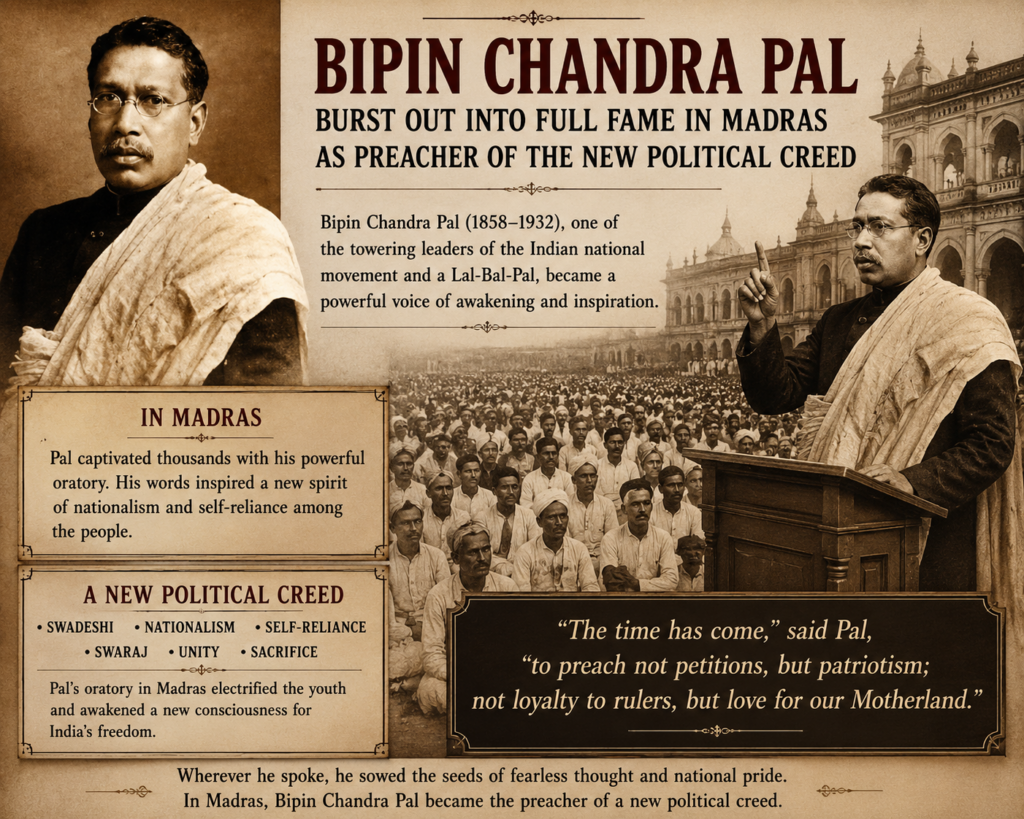
(AI generated image depicting Bipin Chandra Pal in Madras)
The birth of Anushilan Samiti
Anushilan Samiti, founded in 1902 in Kolkata, emerged as one of the earliest and most influential centres of armed revolutionary activity in India’s freedom struggle, with a reach extending beyond Bengal to the national level. Initially, the organisation functioned as a platform for physical training while also conducting classes on nationalism and cultural awareness. Leading nationalist figures such as Sakharam Ganesh Deuskar, revolutionary leader Pramatha Mitra, and Sister Nivedita regularly addressed members. Pramatha Mitra served as President of the Samiti, while Aurobindo Ghose and the young barrister Chittaranjan Das were its Vice-Presidents.
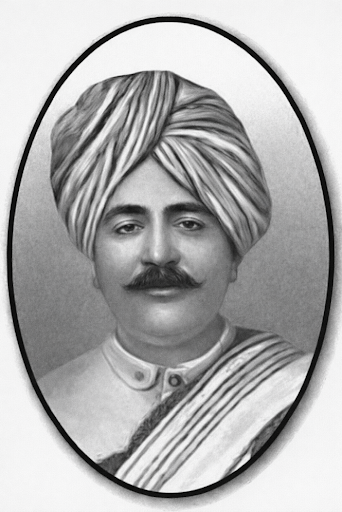
Deuskar was a Marathi nationalist writer from Bengal, who started Shivaji Festival in Bengal to invoke patriotic feelings among the people (as Tilak did in Maharashtra or in Bombey Province)
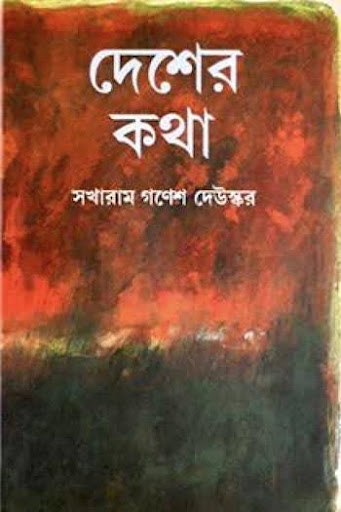
Sakharam Ganesh Deuskar’s famous book in Bengali “Desher Katha” showed the negative impact of British colonialism’s on the Indian economy, which inspired greatly the youth of Bengal to stand against the colonial rule
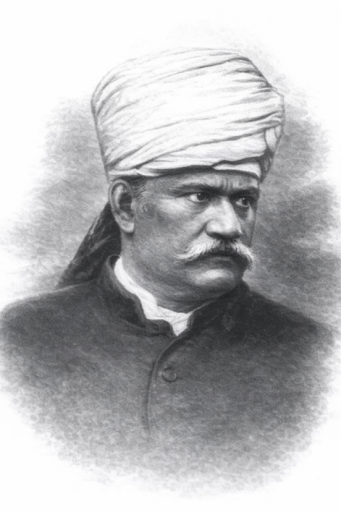
Barrister and a nationalist leader was among the founding members of the Indian revolutionary organisation, Anushilan Samiti
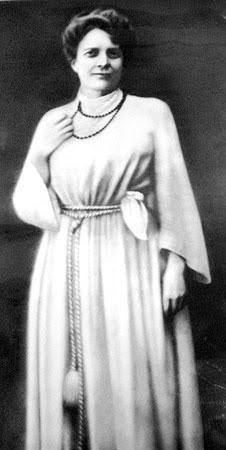
Margaret Elizabeth Noble or Sister Nivedita was the disciple of Swami Vivekananda, an Irish–Indian philosopher, an educator, writer, social activist and one of the greatest inspirational figures of Indian freedom movement, who dedicated her life for the service of the people of India
Initiation of members to the samiti
As the Anushilan Samiti expanded its activities, branches were established across various districts of Bengal. One of the most significant branches was opened in Dhaka in 1905 by Bipin Chandra Pal and Pramatha Mitra. Purnachandra Das was appointed as the in-charge of the Dhaka branch, which soon became a vital centre of revolutionary activities. The members of the samiti had gradations and they has to pass from the lower grades to a higher grade on the basis of skills and trustworthiness. At every stage the members had to take different vows, like ‘Adya’ for first stage,’Antya’ for final, ‘Pratham Bises as first special and ‘Dwitiya Bises’ was second special vows.
The First Vow
- I shall never dissociate myself from the samiti.
- I shall always conform to the Rules of the samiti, shall obey without question the order of the authorities, shall always speak the truth to the leaders and shall never suppress anything
The Intermediate Vow
- I shall never communicate the internal matters of the samiti to anybody.
- I shall never quit my place of work without informing the leader, shall imidiately intimate him any information about a conspiracy against the samiti and shall try to meet the situation as directed by him.
The Final Vow
- I shall not leave the organization till the objective is achieved. Love of parents, brothers and sisters and attraction for home shall not make me neglect my duties or falter in the execution of the directions of my leader.
- If I violate this vow, may I be destroyed by the curse of the Brahmins, of my parents, and of the patriots of all countries.
There was a proper religious procedure followed for initiation of members into the samiti, when a number of members had to be initiated the same were done at a Kali Temple.
The Arrival of Jugantar Party
- As the functioning of the Anushilan Samiti progressed P. Mitra and Barindra Kumar Ghose
developed some differences on the programme of work. - Barindra Kumar Ghose and his followers devoted themselves in procurement of arms,
manufacturing of bombs and to begin an armed revolution. - A journal known as Jugantar (edited by Bhupendranath Dutta, who was Swami
Vivekananda’s brother) became the mouthpiece of the newly created group and its ideology. - Bhupendranath Dutta, Upendranath Banerji, Debabrata Bose, Abinash Chandra
Bhattacharya, Kiran Chandra Mukherjee and of course Barindra Kumar Ghose contributed
articles for Jugatar. - The anti-British, fiery articles became very popular and the government ordered against the
publication of the journal. - Inspire of the ban, Jugantor’s undercover publication continued due to its huge popularity
among the common masses. - The new group formed by Barindra Kumar Ghose also gets the name as Juganta Party.
- Many branches of Anushilan Samiti without changing their affiliation stated following the
path of Jugantar Party. - However, in spite of being two separate organizations, both Anushilan Samiti and Jugantar
collaborated with each other on many occasions as both had the ultimate aim of making
India free from foreign rule.
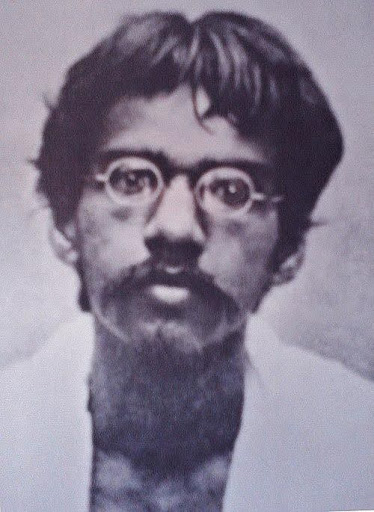
(this image is in public domain, collected from Wikipedia)
Barindra Kumar Ghose or popularly Barin Ghose was a well-known Indian revolutionary and journalist. He founded the revolutionary group Jugantar Party. Ghose was the younger brother of revolutionary and spiritual leader Aurobindo Ghose or Sri Aurobindo.
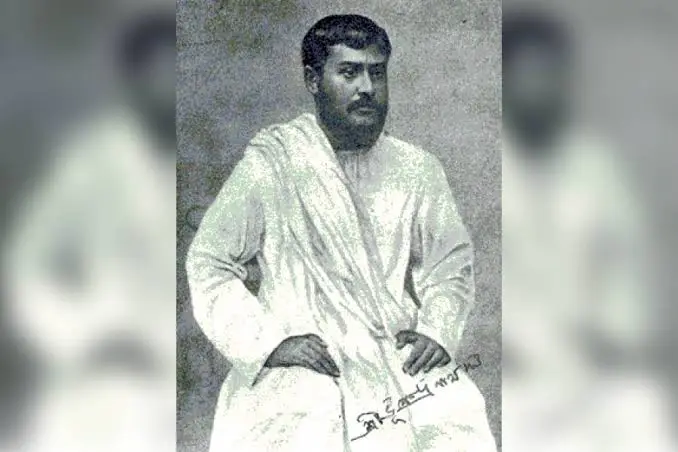
(this image is in public domain, collected from Wikipedia)
Bhupendranath Dutta was an Indian revolutionary and the editor of the famous revolutionary journal ‘Jugantar’, Dutta was also a noted sociologist and anthropologist. He was younger brother of Swami Vivekananda
Bomb Manufacturing & getting ready to hit
Revolutionary Hemchandra Das Kanungo was an important member of the Anushilan Samiti, travelled to Paris in 1907 and learnt the technique of assembling picric acid bombs from exiled Russian revolutionaries. Kanungo’s knowledge was disseminated throughout Indian revolutionary organisations.
Hemchandra was probably the first revolutionary from India who went abroad to obtain military and political training. He returned from Paris to India in January 1908. He established a secret bomb factory at Maniktala in Kolkata.
Revolutionary Ullaskar Dutta was associated with both Anushilan Samiti and Jugantar Party of Bengal, and was a close associate of Barindra Ghose. He was the principal bomb maker of the Jugantar Party. And, now the Anushilan Samiti & Jugantar Party were gearing up for striking hard at the British administration using their secret network.
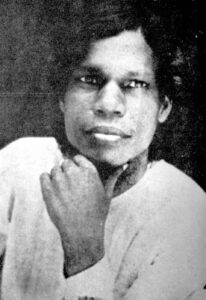
Eminent revolutionary, who learnt bomb making & disseminated the same throughout Indian revolutionary organisations
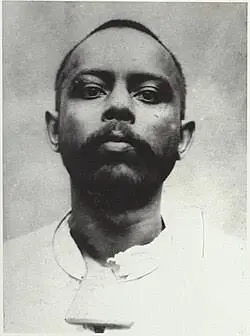
(this image is in public domain, collected from Wikipedia)
Eminent revolutionary, a member of the Jugantar Party and an expert in bomb making. Dutta was deported to Andamans (Cellular Jail) by the British government for his revolutionary activities against the British colonial rule in India