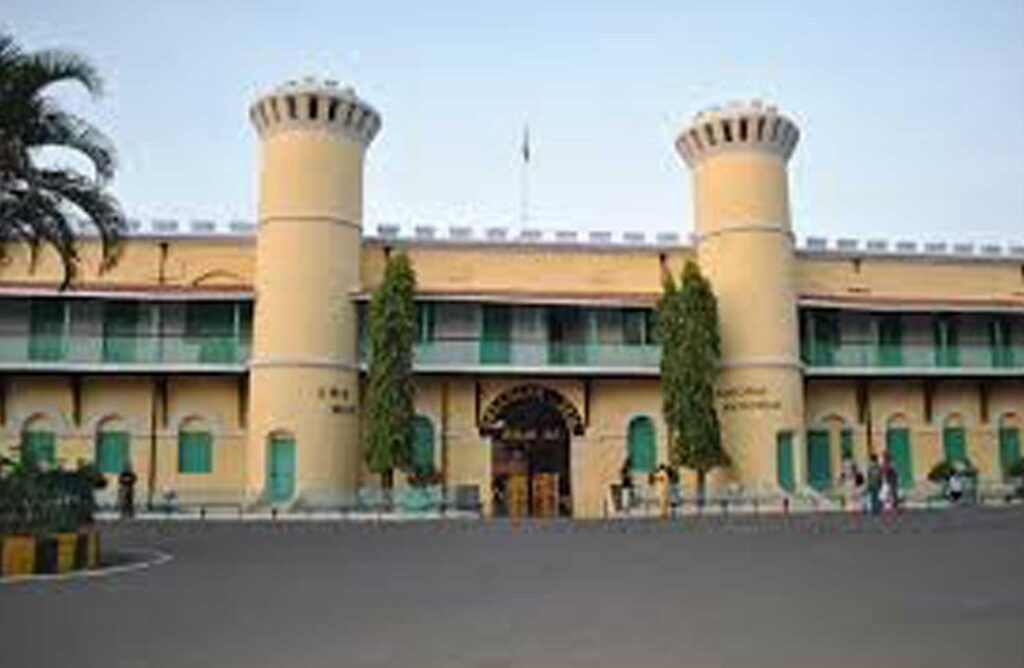
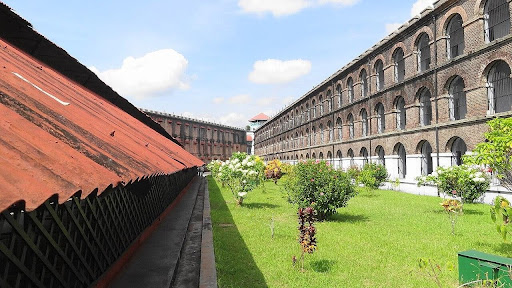
(image collected from Wikipedia, by Jomesh – Own work, CC BY 3.0, https://commons.wikimedia.org/w/index.php?curid=12873773)
The Cellular Jail, known as Kālā Pānī (“Black Water”), was the infamous British colonial prison located in the Andaman and Nicobar Islands. It was primarily used by the colonial government to exile and incarcerate revolutionary freedom fighters or the political prisoners who resisted British rule in India. Many prominent figures of India’s independence movement endured harsh imprisonment within its walls. Today, the Cellular Jail stands as a solemn National Memorial, preserving the legacy and sacrifices of those who fought for the nation’s freedom.
Fortress of Brave Souls
The Cellular Jail, the name which was a symbol of inhuman brutality towards the freedom fighters, who were fighting against the illegitimate colonial power to free their motherland, was constructed between 1896 and 1906, the British authorities had been using the Andaman Islands as a penal settlement since the period immediately following the First War of Independence in 1857. After suppressing the uprising with great severity, the East India Company tried and sentenced many of the captured rebels. While numerous prisoners were executed, others were condemned to transportation for life to the Andamans, a punishment intended to isolate them permanently and prevent any further participation in anti-colonial activities. In the aftermath of the uprising, nearly two hundred rebels were deported to the islands.
The prison complex was designed as a formidable instrument of isolation and surveillance. It comprised seven wings radiating from a central watchtower, which served as the nerve centre of the structure and enabled guards to maintain constant vigilance over the inmates. The wings extended outward in straight lines, resembling the spokes of a wheel, a design that maximised both control and visibility. Each wing rose three storeys high, and the entire complex contained 696 individual cells.
Unlike conventional prisons of the period, the facility had no dormitories; every prisoner was confined in strict solitary isolation. Each cell measured approximately 4.5 metres by 2.7 metres, with a small ventilator positioned high on the wall at about three metres above the floor, allowing minimal light and air. The very name “Cellular Jail” derived from this system of solitary confinement, intended to sever all communication between prisoners. The architectural layout reinforced this purpose: each wing was positioned so that the front of one row of cells faced the rear of another, making any form of contact or communication between inmates virtually impossible. This deliberate design reflected the colonial authorities’ intent to impose not merely physical confinement but psychological isolation.
The Revolutionary Heroes from Bengal at the Kalapani
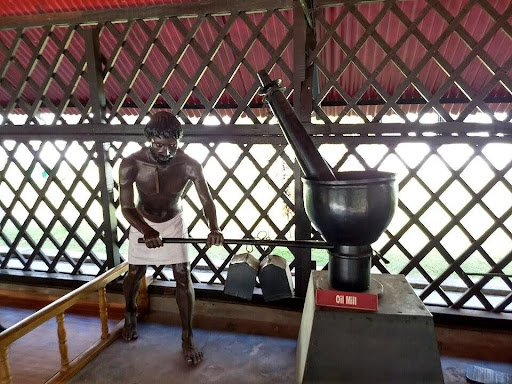
Many revolutionaries from Bengal were sent to the Andamans just after the Alipore Bomb Case, which included Barindra Kumar Ghose, Ullaskar Dutta and other. That was only the beginning, the brave hearts from Bengal were not afraid of the consequences, if it is deportation for life at Cellular Jail or accepting death for the liberation of their motherland. At the Cellular Jail, all the prisoners had to live in very unhygienic conditions, eat half cooked, even at times rotten food, they often had to suffer from abdominal pain and diarrhoea, and complaints in this regard would invite harsh punishment or withdrawal of food. The political prisoners had to do hard jobs throughout the day, the main two tasks were, coir rope making and running or turning the oil mill, which were done to break their determination and brutal test of their mental and physical strength. Due to the inhuman treatment, in 1912, young revolutionary Indu Bhushan Roy had to commit suicide, Ullaskar Dutta had to face unthinkable torture at the cellular jail, even when he was severely ill and he lost his mental balance.
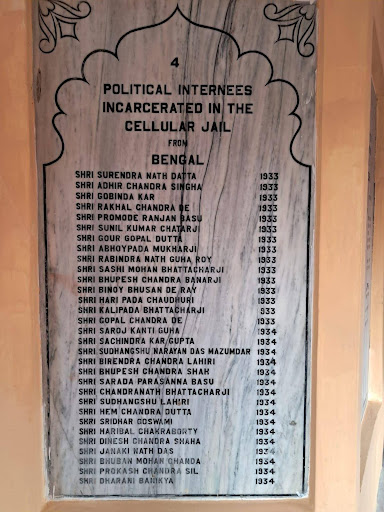
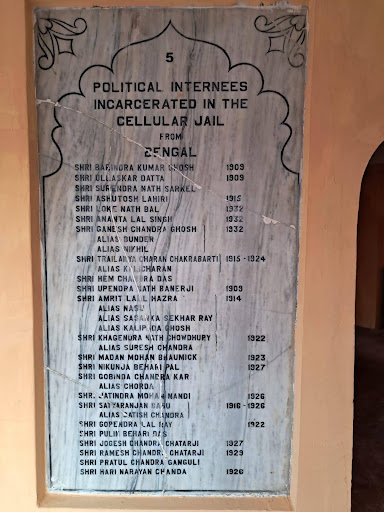
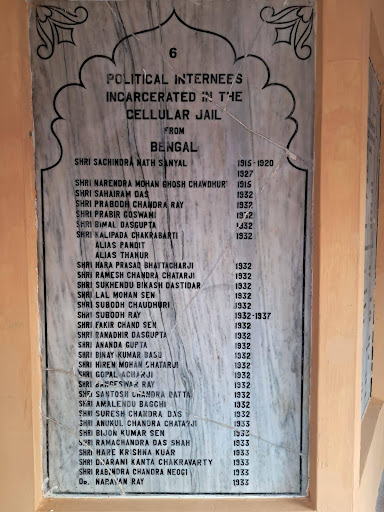
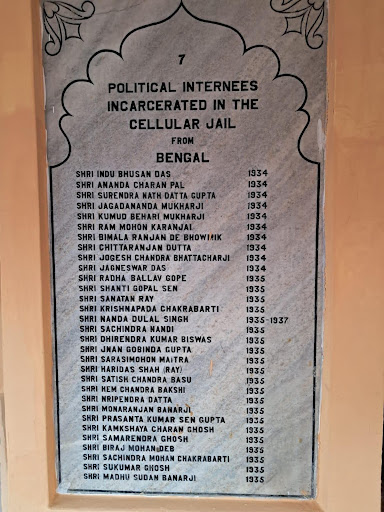
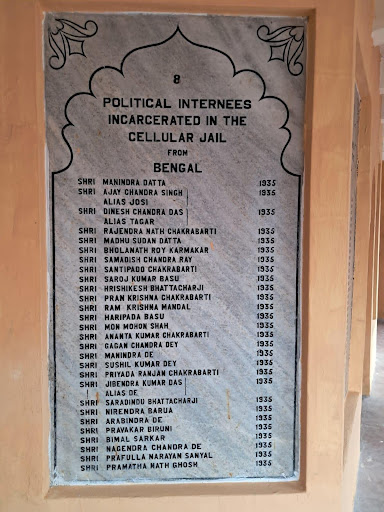
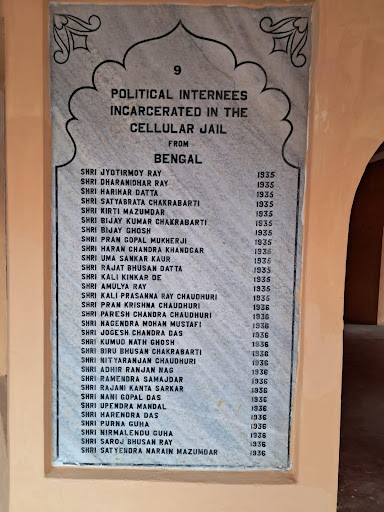
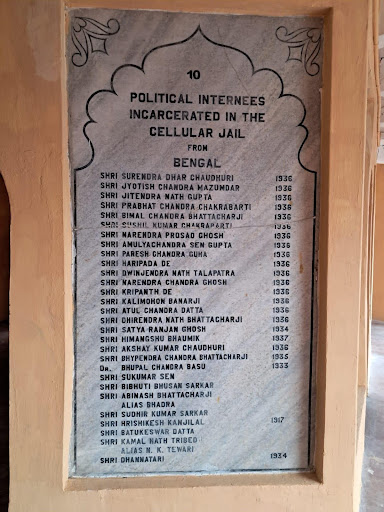
Following are the lists of the freedom fighters from Bengal who were sent to the Cellular Jail, mentioned on the walls of the present day Cellular Jail, which is now a national monument and a museum:
(images are photographed by Mrs. Chandreyee Chatterjee)
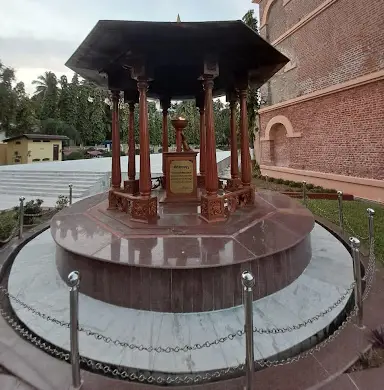
Recently installed continuous burning flame at the Cellular Jail
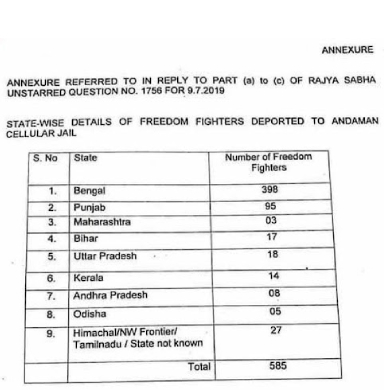
The sacrifices made by the revolutionary freedom fighters from undivided Bengal can easily be understood from this image (courtesy: Shri Sanjeev Sanyal)
Memories of exile by the brave souls
The lives of the political prisoners at the Cellular Jail could be understood by going through the books or biographies written by the revolutionary heroes. Some famous books written by the Bengali revolutionaries are:
The Tale of My Exile or Dwipantarer Kotha written by Barindra Kumar Ghosh
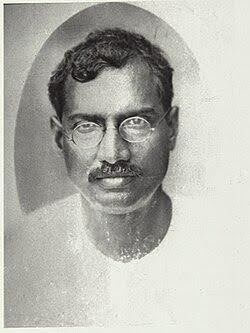
Revolutionary leader and main founder of Jugantar Party Barindra Kumar Ghose received death sentence along with revolutionary Ullaskar Dutta in 1909 in the Alipore Bomb Case. However, the sentence was reduced to life imprisonment at the Andamans for Ghose and Ullaskar along with other convicts. Barindra could successfully managed to the Cellular Jail flee in 1915. But the British authorities were ultimately able to catch him from Puri and was sent to the Cellular Jail, where he was kept under solitary confinement for 5 long years. Ghose returned to Kolkata after his release in 1920. He wrote about his experiences being at the Cellular Jail in his book The Tale of My Exile or Dwipantarer Kotha.
Jele Trish Bachhar or Thirty Years in Jail by revolutionary Trailokyanath Chakraborty
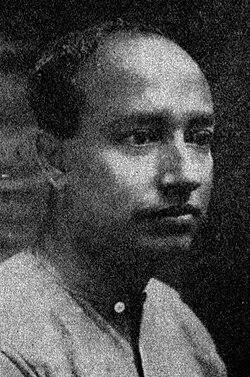
A renowned revolutionary freedom fighter Trailokyanath Chakraborty, was born in 1889 in Mymensingh in present-day Bangladesh. At a young age he became one of the leaders of the Anushilan Samiti’s Dhaka branch. He was jailed on many occasions for his revolutionary activities and he learnt many languages, many of these languages he learnt in jail from his fellow prisoners. He was one of the chief accused in the Barisal Conspiracy Case of 1913, was sentenced by the British and transported to the Andamans as a result. He spent 30 years in various jails in India (including Cellular Jail) and also in Mandalaya in Burma (Myanmar). His book Jele Trish Bachhar or Thirty Years in Jail is a masterpiece on the life of the political prisoners at the Cellular Jail.
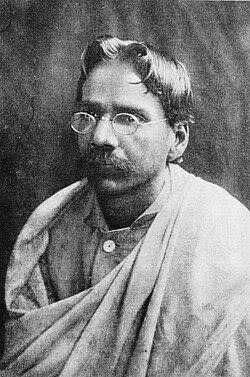
Barindra Kumar Ghose
(image collected from Wikipedia)
Trailokyanath Chakraborty (1889 – 1970)
(image collected from Wikipedia)
The Barisal Conspiracy Case of 1913 was a trial prosecuted by the British colonial authorities against 44 Bengalis who were accused of planning to incite rebellion against the Raj and associated leaders were Trailokyanath Chakravarty and Pratul Chandra Ganguli. As such, it was part of the greater movement for independence that swept India in the decades prior to the independence of India in 1947. Judgment was passed in January 1914, among the 44 accused, 32 were discharged or pardoned, or had the cases against them withdrawn.
Some other important members among the tried revolutionaries in this case were:
Madan Mohan Bhaumik (alias Kulada Prasad Ray): Arrested later and sentenced to 10 years.
Khagendra Nath Chaudhari (alias Suresh Chandra Chaudhari): Arrested later and sentenced to 10 years.
Jatindranath Roy (alias Fegu Roy): Arrested and sentenced in connection to political dacoities.
Satish Chandra Mukherjee: Teacher of Braja Mohan School and a leader of the Barisal society.
Narendra Mohan Ghosh Choudhury: An associate of Satish Mukherjee.
Arun Chandra Guha: An associate involved in the movement.
Manoranjan Gupta: An associate involved in the movement.
The remaining 12 pleaded guilty to the charge of conspiracy against the British Crown. Five of the 12 – among them Pratul Chandra – were given lengthy transportation sentences to the Andamans of between 10 and 12 years. The remaining seven convicts were given transportation sentences between two and seven years. The Kolkata daily Amrita Bazar Patrika had published a series of articles commenting on the case. A show cause motion was brought against the editor Motilal Ghose and the publisher of the newspaper, charging them with contempt of court. However, the motion was later dismissed by a special branch of the High Court.
Pratul Chandra Ganguli (1884-1957)
(image collected from Wikipedia)
Ganguli was born in Narayanganj (present day Bangladesh), on April 16, 1884 and was an important member of the Dhaka Anushilan Samiti. He was tried in the Barisal conspiracy case and was sentenced for 10 years imprisonment in 1914 at the Andamans, however he was released earlier.
Bandi Jeevan or A Life of Captivitywritten by Sachindranath Sanyal:
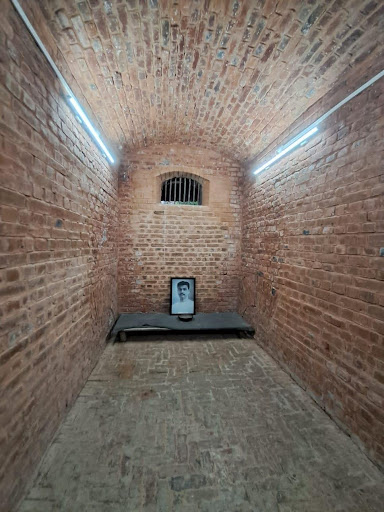
Famous revolutionary leader Sachindranath Sanyal, who founded the Patna Anushilan Samiti, Hindustan Republican Association and mentored young revolutionaries like Bhagat Singh and Chandrashekhar Azad was sent to the Andamans twice. Being in the Cellular Jail, Sanyal write his auto biography Bandi Jeevan or A Life of Captivity, this is considered as a great historical document to understand the British authority’s treatment towards the political prisoners.
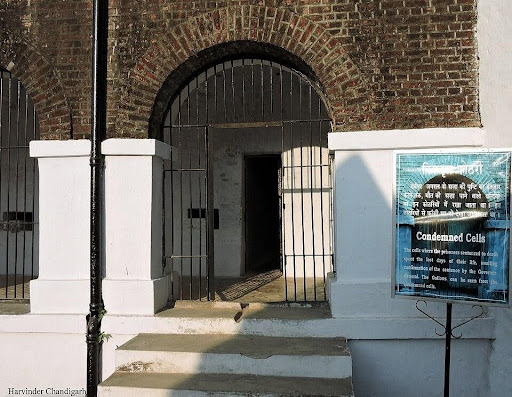
The present day Cellular Jail Museum depicts the cell where Sachindranath Sanyal was kept
(photographed by Mrs. Chandreyee Chatterjee)
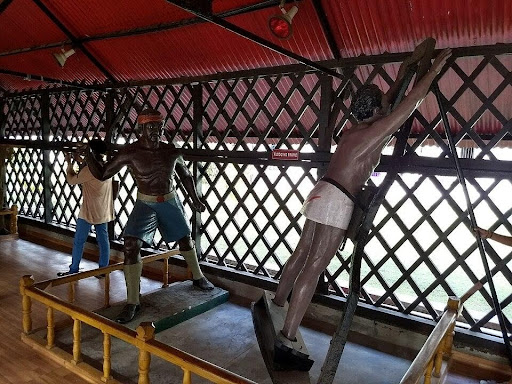
Cellular Jail museum exhibits the cruelties of the past
Exhibit at Cellular Jail: flogging frame: Inmates who dared to raise their voices against British discrimination, were punished like this